


Page 125 - Encyclopedia of Aquarium and Pond Fish, 3rd Edition
P. 125
CATFISH/CORYDORAS    123


          Corydoras melanistius           Corydoras paleatus              Corydoras pygmaeus
         Black Sail Corydoras            Peppered Corydoras               Pygmy Catfish

           ORIGINS  South America, where it is restricted to the   ORIGINS  South America, occurring in southeastern parts   ORIGINS  South America, occurring in Brazil in the Rio
           Orinoco River in Venezuela.     of Brazil and the La Plata basin, Argentina.  Madeira and its tributaries.
           SIZE  2 ⁄2 in (6 cm).           SIZE  2 ⁄4 in (7 cm).            SIZE  1 in (2.5 cm).
              1
                                               3
           DIET  Live foods and prepared catfish foods.  DIET  Live foods and prepared catfish foods.  DIET  Live foods, algae, and prepared catfish foods.
           WATER  Temperature 68–75°F (20–24°C); soft to hard   WATER  Temperature 66–79°F (19–26°C); soft to hard   WATER  Temperature 72–79°F (22–26°C); soft to hard
           (50–150 mg/l) and acidic to neutral (pH 6.0–7.0).  (50–150 mg/l) and acidic to neutral (pH 6.0–7.0).  (50–150 mg/l) and acidic to neutral (pH 6.0–7.0).
           TEMPERAMENT  Peaceful and social.  TEMPERAMENT  Peaceful and social.  TEMPERAMENT  Peaceful and social.
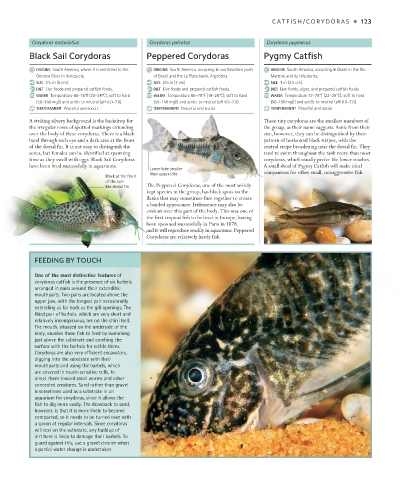
         A striking silvery background is the backdrop for                These tiny corydoras are the smallest members of
         the irregular rows of spotted markings extending                 the group, as their name suggests. Aside from their
         over the body of these corydoras. There is a black               size, however, they can be distinguished by their
         band through each eye and a dark area at the front               pattern of horizontal black stripes, with the
         of the dorsal fin. It is not easy to distinguish the             central stripe broadening near the dorsal fin. They
         sexes, but females can be identified at spawning                 tend to swim throughout the tank more than most
         time as they swell with eggs. Black Sail Corydoras               corydoras, which usually prefer the lower reaches.
         have been bred successfully in aquariums.                        A small shoal of Pygmy Catfish will make ideal
                                          Lower lobe smaller
                                          than upper lobe                 companions for other small, nonaggressive fish.
                              Black at the front
                              of the sail-
                              like dorsal fin  The Peppered Corydoras, one of the most widely
                                         kept species in the group, has black spots on the
                                         flanks that may sometimes fuse together to create
                                         a banded appearance. Iridescence may also be
                                         evident over this part of the body. This was one of
                                         the first tropical fish to be bred in Europe, having
                                         been spawned successfully in Paris in 1878,
                                         and it will reproduce readily in aquariums. Peppered
                                         Corydoras are relatively hardy fish.

           FEEDING BY TOUCH

           One of the most distinctive features of
           corydoras catfish is the presence of six barbels
           arranged in pairs around their extendible
           mouthparts. Two pairs are located above the
           upper jaw, with the longest pair occasionally
           extending as far back as the gill openings. The
           third pair of barbels, which are very short and
           relatively inconspicuous, are on the chin itself.
           The mouth, situated on the underside of the
           body, enables these fish to feed by swimming
           just above the substrate and combing the
           surface with the barbels for edible items.
           Corydoras are also very efficient excavators,
           digging into the substrate with their
           mouthparts and using the barbels, which
           are covered in touch-sensitive cells, to
           direct them toward small worms and other
           concealed creatures. Sand rather than gravel
           is sometimes used as a substrate in an
           aquarium for corydoras, since it allows the
           fish to dig more easily. The drawback to sand,
           however, is that it is more likely to become
           compacted, so it needs to be turned over with
           a spoon at regular intervals. Since corydoras
           will rest on the substrate, any buildup of
           dirt here is likely to damage their barbels. To
           guard against this, use a gravel cleaner when
           a partial water change is undertaken.


   US_122-123_Corydoras_1.indd   123                                                                 29/08/18   4:09 PM

