


Page 147 - Encyclopedia of Aquarium and Pond Fish, 3rd Edition
P. 147
CICHLIDS/DWARF CICHLIDS    145


          Apistogramma nijsseni
                                           FACTORS INFLUENCING BREEDING
         Nijssen’s Dwarf Cichlid
                                           Suitable retreats in the aquarium are vital for   be that this is also the case with other group
           ORIGINS  South America, in the lower Rio Ucayali and   successful breeding with Apistogramma dwarf   members. When the water temperature is above
           the Rio Yavari in Peru.         cichlids, because these fish are cave-spawners.   84.4°F (29.1°C) only male fish result, while the
           SIZE  3 ⁄2 in (9 cm).           The female, such as the Cockatoo Dwarf pictured   offspring are all female when the water is
              1
           DIET  Prepared foods and small live foods.  here, instinctively seeks out a site that affords   68–73°F (20–23°C). The influence of pH is
           WATER  Temperature 73–86°F (23–30°C); soft    her relative safety. In Nijssen’s Dwarf (see left),   relatively slight, but the percentage of eggs
           (50–100 mg/l) and acidic (pH 6.0).  environmental conditions have been shown to   that hatch in naturally soft water is much higher
           TEMPERAMENT  Males are territorial.  have a direct impact on breeding, and it may    than in hard water environments.
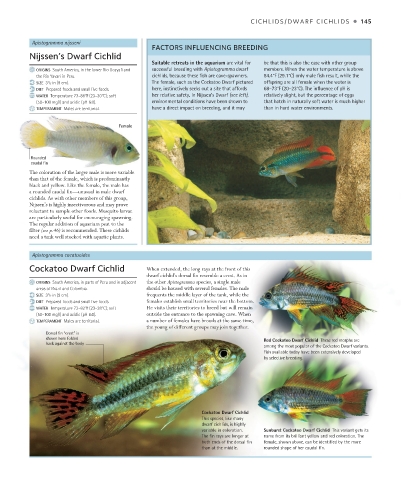
                                  Female


         Rounded
         caudal fin
         The coloration of the larger male is more variable
         than that of the female, which is predominantly
         black and yellow. Like the female, the male has
         a rounded caudal fin—unusual in male dwarf
         cichlids. As with other members of this group,
         Nijssen’s is highly insectivorous and may prove
         reluctant to sample other foods. Mosquito larvae
         are particularly useful for encouraging spawning.
         The regular addition of aquarium peat to the
         filter (see p.46) is recommended. These cichlids
         need a tank well stocked with aquatic plants.

          Apistogramma cacatuoides
         Cockatoo Dwarf Cichlid          When extended, the long rays at the front of this
                                         dwarf cichlid’s dorsal fin resemble a crest. As in
           ORIGINS  South America, in parts of Peru and in adjacent   the other Apistogramma species, a single male
           areas of Brazil and Colombia.  should be housed with several females. The male
           SIZE  3 ⁄2 in (9 cm).         frequents the middle layer of the tank, while the
              1
           DIET  Prepared foods and small live foods.  females establish small territories near the bottom.
           WATER  Temperature 73–82°F (23–28°C); soft    He visits their territories to breed but will remain
           (50–100 mg/l) and acidic (pH 6.0).  outside the entrance to the spawning cave. When
           TEMPERAMENT  Males are territorial.  a number of females have broods at the same time,
                                         the young of different groups may join together.
              Dorsal fin “crest” is
              shown here folded                                           Red Cockatoo Dwarf Cichlid  These red morphs are
              back against the body                                       among the most popular of the Cockatoo Dwarf variants.
                                                                          Fish available today have been extensively developed
                                                                          by selective breeding.


                                                         Cockatoo Dwarf Cichlid
                                                         This species, like many
                                                         dwarf cichlids, is highly
                                                         variable in coloration.    Sunburst Cockatoo Dwarf Cichlid  This variant gets its
                                                         The fin rays are longer at   name from its brilliant yellow and red coloration. The
                                                         both ends of the dorsal fin   female, shown above, can be identified by the more
                                                         than at the middle.  rounded shape of her caudal fin.


   US_144-145_Dwarf_Cichlids.indd   145                                                              29/08/18   4:09 PM

