


Page 148 - Encyclopedia of Aquarium and Pond Fish, 3rd Edition
P. 148
146    FRESHWATER FISH DIRECTORY


          Etroplus maculatus              Etroplus suratensis             Pelvicachromis subocellatus
         Orange Chromide                 Green Chromide                   Eyespot Krib

           ORIGINS  Asia, found in western coastal areas of India   ORIGINS  Asia, occurring in coastal parts of India and   ORIGINS  Western Africa, where it is widely distributed,
           and Sri Lanka.                  also Sri Lanka.                  from Gabon to the Congo River in Zaire.
           SIZE  3 in (7.5 cm).            SIZE  18 in (45 cm).             SIZE  4 in (10 cm).
           DIET  Prepared cichlid foods and live foods.  DIET  Prepared cichlid foods, algae, and live foods.  DIET  Prepared cichlid foods, algae, and live foods.
           WATER  Temperature 68–79°F (20–26°C); hard    WATER  Temperature 72–79°F (22–26°C); hard    WATER  Temperature 75–79°F (24–26°C); hard
           (150–200 mg/l) and neutral to alkaline (pH 7.0–7.5).  (150–200 mg/l) and alkaline (pH 7.5–8.0).  (100–150 mg/l) and acidic (pH 6.5).
           TEMPERAMENT  Not aggressive.    TEMPERAMENT  Can be intolerant.  TEMPERAMENT  Territorial when breeding.
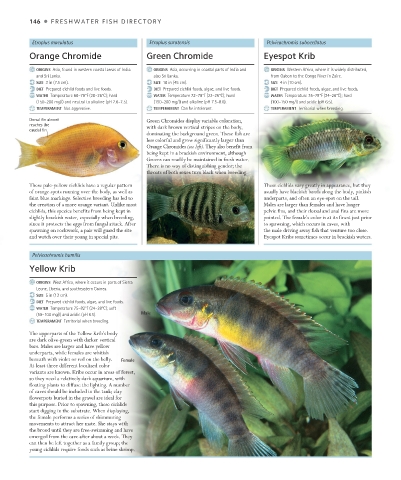
         Dorsal fin almost               Green Chromides display variable coloration,
         reaches the                     with dark brown vertical stripes on the body,
         caudal fin
                                         dominating the background green. These fish are
                                         less colorful and grow significantly larger than
                                         Orange Chromides (see left). They also benefit from
                                         being kept in a brackish environment, although
                                         Greens can readily be maintained in fresh water.
                                         There is no way of distinguishing gender; the
                                         throats of both sexes turn black when breeding.
         These pale-yellow cichlids have a regular pattern                These cichlids vary greatly in appearance, but they
         of orange spots running over the body, as well as                usually have blackish bands along the body, pinkish
         faint blue markings. Selective breeding has led to               underparts, and often an eye-spot on the tail.
         the creation of a more orange variant. Unlike most               Males are larger than females and have longer
         cichlids, this species benefits from being kept in               pelvic fins, and their dorsal and anal fins are more
         slightly brackish water, especially when breeding,               pointed. The female’s color is at its finest just prior
         since it protects the eggs from fungal attack. After             to spawning, which occurs in caves, with
         spawning on rockwork, a pair will guard the site                 the male driving away fish that venture too close.
         and watch over their young in special pits.                      Eyespot Kribs sometimes occur in brackish waters.

          Pelvicachromis humilis
         Yellow Krib

           ORIGINS  West Africa, where it occurs in parts of Sierra
           Leone, Liberia, and southeastern Guinea.
           SIZE  5 in (13 cm).
           DIET  Prepared cichlid foods, algae, and live foods.
           WATER  Temperature 75–82°F (24–28°C); soft
           (50–100 mg/l) and acidic (pH 6.5).   Male
           TEMPERAMENT  Territorial when breeding.
         The upperparts of the Yellow Krib’s body
         are dark olive-green with darker vertical
         bars. Males are larger and have yellow
         underparts, while females are whitish
         beneath with violet or red on the belly.    Female
         At least three different localized color
         variants are known. Kribs occur in areas of forest,
         so they need a relatively dark aquarium, with
         floating plants to diffuse the lighting. A number
         of caves should be included in the tank; clay
         flowerpots buried in the gravel are ideal for
         this purpose. Prior to spawning, these cichlids
         start digging in the substrate. When displaying,
         the female performs a series of shimmering
         movements to attract her mate. She stays with
         the brood until they are free-swimming and have
         emerged from the cave after about a week. They
         can then be left together as a family group; the
         young cichlids require foods such as brine shrimp.


   US_146-147_Asian_African.indd   146                                                               29/08/18   4:09 PM

