


Page 149 - Encyclopedia of Aquarium and Pond Fish, 3rd Edition
P. 149
CICHLIDS/ASIAN AND AFRICAN CICHLIDS    147


          Nanochromis parilus                                             Pseudocrenilabrus philander
         Bar-Tailed Dwarf Cichlid                                         South African Mouth-Brooder

           ORIGINS  Africa, occurring in the Zaire River basin,             ORIGINS  Southern Africa, from Angola, southern Zaire,
           especially in the vicinity of Stanley Pool.                      and Mozambique down to South Africa.
                                                                               1
           SIZE  3 in (8 cm).                                               SIZE  4 ⁄2 in (11 cm).
           DIET  Prepared cichlid foods and live foods.  Male               DIET  Prepared cichlid foods, flake, and live foods.
           WATER  Temperature 75–82°F (24–28°C); soft                       WATER  Temperature 68–79°F (20 –26°C); hard
           (50–100 mg/l) and acidic (pH 6.5).                               (100–150 mg/l) and neutral (pH 7.0).
           TEMPERAMENT  Territorial.                                        TEMPERAMENT  Aggressive and territorial.
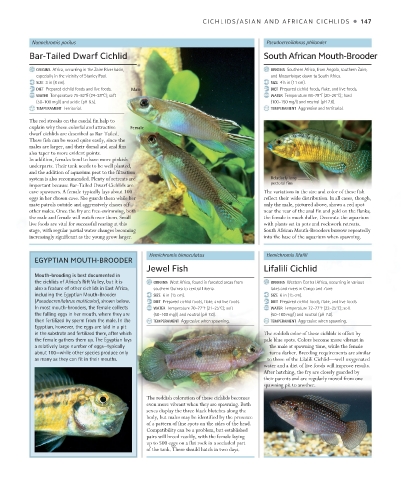
         The red streaks on the caudal fin help to
         explain why these colorful and attractive    Female
         dwarf cichlids are described as Bar-Tailed.
         These fish can be sexed quite easily, since the
         males are larger, and their dorsal and anal fins
         also taper to more evident points.
         In addition, females tend to have more pinkish
         underparts. Their tank needs to be well planted,
         and the addition of aquarium peat to the filtration
         system is also recommended. Plenty of retreats are                 Relatively long
         important because Bar-Tailed Dwarf Cichlids are                    pectoral fins
         cave-spawners. A female typically lays about 100                 The variations in the size and color of these fish
         eggs in her chosen cave. She guards them while her               reflect their wide distribution. In all cases, though,
         mate patrols outside and aggressively chases off                 only the male, pictured above, shows a red spot
         other males. Once the fry are free-swimming, both                near the rear of the anal fin and gold on the flanks;
         the male and female will watch over them. Small                  the female is much duller. Decorate the aquarium
         live foods are vital for successful rearing at this              with plants set in pots and rockwork retreats.
         stage, with regular partial water changes becoming               South African Mouth-Brooders burrow repeatedly
         increasingly significant as the young grow larger.               into the base of the aquarium when spawning.

                                          Hemichromis bimaculatus         Hemichromis lifalili
           EGYPTIAN MOUTH-BROODER
                                         Jewel Fish                       Lifalili Cichlid
           Mouth-brooding is best documented in
           the cichlids of Africa’s Rift Valley, but it is    ORIGINS  West Africa, found in forested areas from   ORIGINS  Western Central Africa, occurring in various
           also a feature of other cichlids in East Africa,   southern Guinea to central Liberia.   lakes and rivers in Congo and Zaire.
           including the Egyptian Mouth-Brooder   SIZE  6 in (15 cm).       SIZE  6 in (15 cm).
           (Pseudocrenilabrus multicolor), shown below.   DIET  Prepared cichlid foods, flake, and live foods.  DIET  Prepared cichlid foods, flake, and live foods.
           In most mouth-brooders, the female collects   WATER  Temperature 70–77°F (21–25°C); soft   WATER  Temperature 72–77°F (22–25°C); soft
           the falling eggs in her mouth, where they are   (50–100 mg/l) and neutral (pH 7.0).  (50–100 mg/l) and neutral (pH 7.0).
           then fertilized by sperm from the male. In the   TEMPERAMENT  Aggressive when spawning.  TEMPERAMENT  Aggressive when spawning.
           Egyptian, however, the eggs are laid in a pit
           in the substrate and fertilized there, after which             The reddish color of these cichlids is offset by
           the female gathers them up. The Egyptian lays                  pale blue spots. Colors become more vibrant in
           a relatively large number of eggs—typically                     the male at spawning time, while the female
           about 100—while other species produce only                      turns darker. Breeding requirements are similar
           as many as they can fit in their mouths.                        to those of the Lilalili Cichlid—well-oxygenated
                                                                          water and a diet of live foods will improve results.
                                                                          After hatching, the fry are closely guarded by
                                                                          their parents and are regularly moved from one
                                                                          spawning pit to another.
                                         The reddish coloration of these cichlids becomes
                                         even more vibrant when they are spawning. Both
                                         sexes display the three black blotches along the
                                         body, but males may be identified by the presence
                                         of a pattern of fine spots on the sides of the head.
                                         Compatibility can be a problem, but established
                                         pairs will breed readily, with the female laying
                                         up to 500 eggs on a flat rock in a secluded part
                                         of the tank. These should hatch in two days.


   US_146-147_Asian_African.indd   147                                                               29/08/18   4:09 PM

