


Page 150 - Encyclopedia of Aquarium and Pond Fish, 3rd Edition
P. 150
148    FRESHWATER FISH DIRECTORY


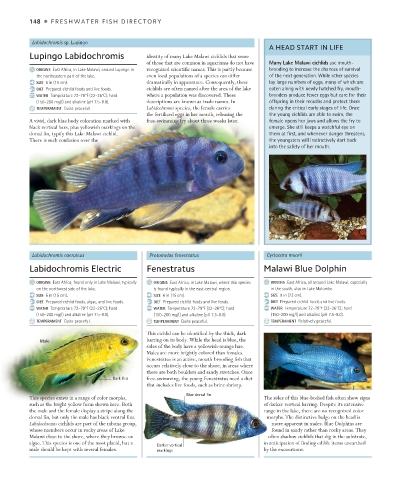
          Labidochromis sp. Lupingo
                                                                           A HEAD START IN LIFE
         Lupingo Labidochromis           identity of many Lake Malawi cichlids that some
                                         of those that are common in aquariums do not have   Many Lake Malawi cichlids use mouth-
           ORIGINS  East Africa, in Lake Malawi, around Lupingo in   recognized scientific names. This is partly because   brooding to increase the chances of survival
           the northeastern part of the lake.  even local populations of a species can differ   of the next generation. While other species
           SIZE  6 in (15 cm).           dramatically in appearance. Consequently, these   lay large numbers of eggs, many of which are
           DIET  Prepared cichlid foods and live foods.  cichlids are often named after the area of the lake   eaten along with newly hatched fry, mouth-
           WATER  Temperature 72–79°F (22–26°C); hard    where a population was discovered. These   brooders produce fewer eggs but care for their
           (150–200 mg/l) and alkaline (pH 7.5–8.0).  descriptions are known as trade names. In   offspring in their mouths and protect them
           TEMPERAMENT  Quite peaceful.  Labidochromis species, the female carries    during the critical early stages of life. Once
                                         the fertilized eggs in her mouth, releasing the    the young cichlids are able to swim, the
         A vivid, dark blue body coloration marked with   free-swimming fry about three weeks later.  female opens her jaws and allows the fry to
         black vertical bars, plus yellowish markings on the               emerge. She still keeps a watchful eye on
         dorsal fin, typify this Lake Malawi cichlid.                      them at first, and whenever danger threatens,
         There is such confusion over the                                  the youngsters will instinctively dart back
                                                                           into the safety of her mouth.


          Labidochromis caeruleus         Protomelas fenestratus          Cyrtocara moorii
         Labidochromis Electric          Fenestratus                      Malawi Blue Dolphin

           ORIGINS  East Africa, found only in Lake Malawi, typically   ORIGINS  East Africa, in Lake Malawi, where this species   ORIGINS  East Africa, all around Lake Malawi, especially
           on the northwest side of the lake.  is found typically in the east-central region.  in the south; also in Lake Malombe.
           SIZE  6 in (15 cm).             SIZE  6 in (15 cm).              SIZE  9 in (23 cm).
           DIET  Prepared cichlid foods, algae, and live foods.  DIET  Prepared cichlid foods and live foods.  DIET  Prepared cichlid foods and live foods.
           WATER  Temperature 72–79°F (22–26°C); hard    WATER  Temperature 72–79°F (22–26°C); hard    WATER  Temperature 72–79°F (22–26°C); hard
           (150–200 mg/l) and alkaline (pH 7.5–8.0).  (150–200 mg/l) and alkaline (pH 7.5–8.0).  (150–200 mg/l) and alkaline (pH 7.5–8.0).
           TEMPERAMENT  Quite peaceful.    TEMPERAMENT  Quite peaceful.     TEMPERAMENT  Relatively peaceful.
                                         This cichlid can be identified by the thick, dark
            Male                         barring on its body. While the head is blue, the
                                         sides of the body have a yellowish-orange hue.
                                         Males are more brightly colored than females.
                                         Fenestratus is an active, mouth-brooding fish that
                                         occurs relatively close to the shore, in areas where
                                         there are both boulders and sandy stretches. Once
                                Dark fins  free-swimming, the young Fenestratus need a diet
                                         that includes live foods, such as brine shrimp.
                                                    Blue dorsal fin
         This species exists in a range of color morphs,                  The sides of this blue-bodied fish often show signs
         such as the bright yellow form shown here. Both                  of darker vertical barring. Despite its extensive
         the male and the female display a stripe along the               range in the lake, there are no recognized color
         dorsal fin, but only the male has black ventral fins.             morphs. The distinctive bulge on the head is
         Labidochromis cichlids are part of the mbuna group,                more apparent in males. Blue Dolphins are
         whose members occur in rocky areas of Lake                         found in sandy rather than rocky areas. They
         Malawi close to the shore, where they browse on                   often shadow cichlids that dig in the substrate,
         algae. This species is one of the most placid, but a   Darker vertical   in anticipation of finding edible items unearthed
         male should be kept with several females.  markings              by the excavations.


   US_148-149_African_Lake_Cich.indd   148                                                           29/08/18   4:09 PM

