


Page 152 - Encyclopedia of Aquarium and Pond Fish, 3rd Edition
P. 152
150    FRESHWATER FISH DIRECTORY


          Nimbochromis livingstonii       Sciaenochromis fryeri           Iodotropheus sprengerae
         Livingstoni                     Electric Blue                    Rusty Cichlid

           ORIGINS  East Africa, occurring only in Lake Malawi,   ORIGINS  East Africa, occurring only in Lake Malawi,   ORIGINS  East Africa, occurring only in Lake Malawi,
           where it is widely distributed throughout the lake.   widely distributed along the rocky shoreline.   where it is found in the southeastern part of the lake.
           SIZE  10 in (25 cm).            SIZE  7 in (18 cm).              SIZE  4 in (10 cm).
           DIET  Prepared cichlid foods and live foods.  DIET  Prepared cichlid foods and live foods.  DIET  Prepared cichlid foods and live foods.
           WATER  Temperature 73–79°F (23–26°C); hard    WATER  Temperature 72–79°F (22–26°C); hard    WATER  Temperature 72–79°F (22–26°C); hard
           (150–200 mg/l) and alkaline (pH 7.5–8.0).  (150–200 mg/l) and alkaline (pH 7.5–8.0).  (150–200 mg/l) and alkaline (pH 7.5–8.0).
           TEMPERAMENT  Highly predatory.  TEMPERAMENT  Predatory and territorial.  TEMPERAMENT  Reasonably nonaggressive.
                                         The rich blue of male Electric Blues takes up to
                                         a year to develop. Females are always paler. Like
                                         other mouth-brooding cichlids, eggs are fertilized
                                         in the female’s mouth. Once they emerge, the
                                         young do not return to their mother’s mouth,
                                         even if danger threatens. Males are aggressive
                                         toward other males and fish with a similar
                                         coloration. Electric Blues eat fry in the wild, so
                                         they will prey on smaller species in the tank.
                                                                 Orange-
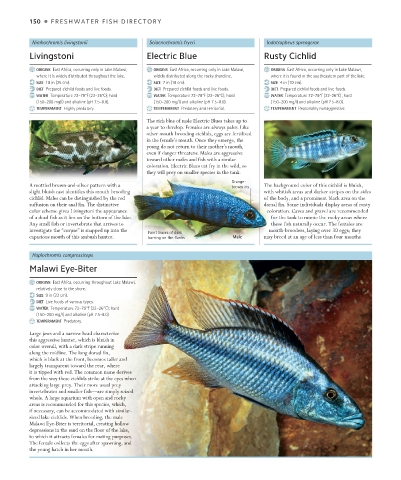
         A mottled brown-and-silver pattern with a               brown iris  The background color of this cichlid is bluish,
         slight bluish cast identifies this mouth-brooding                with whitish areas and darker stripes on the sides
         cichlid. Males can be distinguished by the red                   of the body, and a prominent black area on the
         suffusion on their anal fin. The distinctive                     dorsal fin. Some individuals display areas of rusty
         color scheme gives Livingstoni the appearance                     coloration. Caves and gravel are recommended
         of a dead fish as it lies on the bottom of the lake.               for the tank to mimic the rocky areas where
         Any small fish or invertebrate that arrives to                     these fish naturally occur. The females are
         investigate the “corpse” is snapped up into the   Faint traces of dark   mouth-brooders, laying over 30 eggs; they
         capacious mouth of this ambush hunter.  barring on the flanks  Male  may breed at an age of less than four months.

          Haplochromis compressiceps
         Malawi Eye-Biter

           ORIGINS  East Africa, occurring throughout Lake Malawi,
           relatively close to the shore.
           SIZE  9 in (23 cm).
           DIET  Live foods of various types.
           WATER  Temperature 72–79°F (22–26°C); hard
           (150–200 mg/l) and alkaline (pH 7.5–8.0).
           TEMPERAMENT  Predatory.
         Large jaws and a narrow head characterize
         this aggressive hunter, which is bluish in
         color overall, with a dark stripe running
         along the midline. The long dorsal fin,
         which is black at the front, becomes taller and
         largely transparent toward the rear, where
         it is tipped with red. The common name derives
         from the way these cichlids strike at the eyes when
         attacking large prey. Their more usual prey—
         invertebrates and smaller fish—are simply seized
         whole. A large aquarium with open and rocky
         areas is recommended for this species, which,
         if necessary, can be accommodated with similar-
         sized lake cichlids. When breeding, the male
         Malawi Eye-Biter is territorial, creating hollow
         depressions in the sand on the floor of the lake,
         to which it attracts females for mating purposes.
         The female collects the eggs after spawning, and
         the young hatch in her mouth.


   US_150-151_Lake_Malawi_2.indd   150                                                               29/08/18   4:09 PM

