


Page 153 - Encyclopedia of Aquarium and Pond Fish, 3rd Edition
P. 153
CICHLIDS/LAKE MALAWI CICHLIDS     151


          Copadichromis borleyi           Pseudotropheus joanjohnsonae    Melanochromis auratus
         Red Kadango                     Pearl of Likoma                  Auratus Cichlid

           ORIGINS  East Africa, found only in Lake Malawi, where    ORIGINS  East Africa, in eastern Lake Malawi; also   ORIGINS  East Africa, occurring in eastern Lake Malawi,
           it is widely distributed.       introduced into the southwest part of the lake.  where it is encountered around the rocky shoreline.
           SIZE  6 in (15 cm).             SIZE  4 in (10 cm).              SIZE  4 in (10 cm).
           DIET  Prepared cichlid foods and live foods.  DIET  Prepared cichlid foods, vegetable matter, live foods.  DIET  Prepared cichlid foods, algae, and live foods.
           WATER  Temperature 72–79°F (22–26°C); hard    WATER  Temperature 72–79°F (22–26°C); hard    WATER  Temperature 72–79°F (22–26°C); hard
           (150–200 mg/l) and alkaline (pH 7.5–8.0).  (150–200 mg/l) and alkaline (pH 7.5–8.0).  (150–200 mg/l) and alkaline (pH 7.5–8.0).
           TEMPERAMENT  Quite peaceful.    TEMPERAMENT  Males are territorial but not destructive.  TEMPERAMENT  Males are territorial and aggressive.
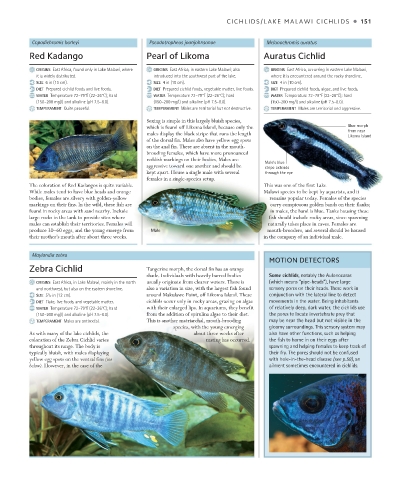
                                         Sexing is simple in this largely bluish species,
                                         which is found off Likoma Island, because only the      Blue morph
                                         males display the black stripe that runs the length     from near
                                                                                                 Likoma Island
                                         of the dorsal fin. Males also have yellow egg spots
                                         on the anal fin. These are absent in the mouth-
                                         brooding females, which have more pronounced
                                         reddish markings on their bodies. Males are   Male’s blue
                                         aggressive toward one another and should be    stripe extends
                                         kept apart. House a single male with several   through the eye
                                         females in a single-species setup.
         The coloration of Red Kadangos is quite variable.                This was one of the first Lake
         While males tend to have blue heads and orange                   Malawi species to be kept by aquarists, and it
         bodies, females are silvery with golden-yellow                    remains popular today. Females of the species
         markings on their fins. In the wild, these fish are                carry conspicuous golden bands on their flanks;
         found in rocky areas with sand nearby. Include                     in males, the band is blue. Tanks housing these
         large rocks in the tank to provide sites where                    fish should include rocky areas, since spawning
         males can establish their territories. Females will               naturally takes place in caves. Females are
         produce 30–60 eggs, and the young emerge from   Male              mouth-brooders, and several should be housed
         their mother’s mouth after about three weeks.                    in the company of an individual male.

          Maylandia zebra
                                                                           MOTION DETECTORS
         Zebra Cichlid                   Tangerine morph, the dorsal fin has an orange
                                         shade. Individuals with heavily barred bodies   Some cichlids, notably the Aulonocaras
           ORIGINS  East Africa, in Lake Malawi, mainly in the north   usually originate from clearer waters. There is    (which means “pipe-heads”), have large
           and northwest, but also on the eastern shoreline.  also a variation in size, with the largest fish found   sensory pores on their heads. These work in
           SIZE  5 ⁄2 in (12 cm).        around Makulawe Point, off Likoma Island. These   conjunction with the lateral line to detect
              1
           DIET  Flake, live foods, and vegetable matter.  cichlids occur only in rocky areas, grazing on algae   movements in the water. Being inhabitants
           WATER  Temperature 72–79°F (22–26°C); hard    with their enlarged lips. In aquariums, they benefit   of relatively deep, dark water, the cichlids use
           (150–200 mg/l) and alkaline (pH 7.5–8.0).  from the addition of spirulina algae to their diet.   the pores to locate invertebrate prey that
           TEMPERAMENT  Males are antisocial.  This is another matriarchal, mouth-brooding   may be near the head but not visible in the
                                                 species, with the young emerging   gloomy surroundings. This sensory system may
         As with many of the lake cichlids, the       about three weeks after   also have other functions, such as helping
         coloration of the Zebra Cichlid varies           mating has occurred.  the fish to home in on their eggs after
         throughout its range. The body is                                 spawning and helping females to keep track of
         typically bluish, with males displaying                           their fry. The pores should not be confused
         yellow egg spots on the ventral fins (see                         with hole-in-the-head disease (see p.58), an
         below). However, in the case of the                               ailment sometimes encountered in cichlids.


   US_150-151_Lake_Malawi_2.indd   151                                                               29/08/18   4:09 PM

