


Page 154 - Encyclopedia of Aquarium and Pond Fish, 3rd Edition
P. 154
152    FRESHWATER FISH DIRECTORY


          Aulonocara baenschi             Aulonocara roberti              Aulonocara jacobfreibergi
         Sunshine Peacock                Orange-Shouldered Peacock        Butterfly Peacock

           ORIGINS  East Africa, restricted to Lake Malawi, though   ORIGINS  East Africa, restricted to Lake Malawi, where it   ORIGINS  East Africa, widely distributed around the rocky
           widely distributed there.       is widely distributed.           shoreline of Lake Malawi.
           SIZE  4 in (10 cm).             SIZE  5 ⁄2 in (12 cm).           SIZE  6 in (15 cm).
                                               1
           DIET  Prepared cichlid foods, live foods, vegetable matter.  DIET  Prepared cichlid foods, live foods, vegetable matter.  DIET  Prepared cichlid foods, live foods, vegetable matter.
           WATER  Temperature 72–79°F (22–26°C); hard    WATER  Temperature 72–79°F (22–26°C); hard    WATER  Temperature 72–79°F (22–26°C); hard
           (150–200 mg/l) and alkaline (pH 7.5–8.0).   (150–200 mg/l) and alkaline (pH 7.5–8.0).   (150–200 mg/l) and alkaline (pH 7.5–8.0).
           TEMPERAMENT  Relatively peaceful.  TEMPERAMENT  Males are antisocial.  TEMPERAMENT  Males are antisocial.
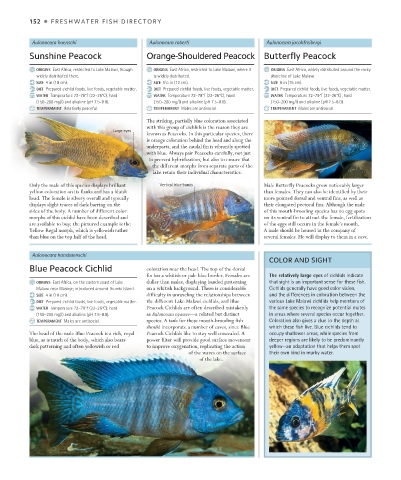
                                         The striking, partially blue coloration associated
                                         with this group of cichlids is the reason they are
                                Large eyes
                                         known as Peacocks. In this particular species, there
                                         is orange coloration behind the head and along the
                                         underparts, and the caudal fin is vibrantly spotted
                                         with blue. Always pair Peacocks carefully, not just
                                          to prevent hybridization, but also to ensure that
                                           the different morphs from separate parts of the
                                           lake retain their individual characteristics.
         Only the male of this species displays brilliant   Vertical blue bands  Male Butterfly Peacocks grow noticeably larger
         yellow coloration on its flanks and has a bluish                 than females. They can also be identified by their
         head. The female is silvery overall and typically                more pointed dorsal and ventral fins, as well as
         displays slight traces of dark barring on the                    their elongated pectoral fins. Although the male
         sides of the body. A number of different color                   of this mouth-brooding species has no egg spots
         morphs of this cichlid have been described and                   on its ventral fin to attract the female, fertilization
         are available to buy; the pictured example is the                of the eggs still occurs in the female’s mouth.
         Yellow Regal morph, which is yellowish rather                    A male should be housed in the company of
         than blue on the top half of the head.                           several females. He will display to them in a cave.

          Aulonocara hansbaenschi
                                                                           COLOR AND SIGHT
         Blue Peacock Cichlid            coloration near the head. The top of the dorsal
                                         fin has a whitish or pale blue border. Females are   The relatively large eyes of cichlids indicate
           ORIGINS  East Africa, on the eastern coast of Lake    duller than males, displaying banded patterning    that sight is an important sense for these fish.
           Malawi near Masinje; introduced around Thumbi Island.  on a whitish background. There is considerable   Cichlids generally have good color vision,
           SIZE  4 in (10 cm).           difficulty in unraveling the relationships between   and the differences in coloration between the
           DIET  Prepared cichlid foods, live foods, vegetable matter.  the different Lake Malawi cichlids, and Blue   various Lake Malawi cichlids help members of
           WATER  Temperature 72–79°F (22–26°C); hard    Peacock Cichlids are often described mistakenly    the same species to recognize potential mates
           (150–200 mg/l) and alkaline (pH 7.5–8.0).  as Aulonocara nyassae—a related but distinct   in areas where several species occur together.
           TEMPERAMENT  Males are antisocial.  species. A tank for these mouth-brooding fish   Coloration also gives a clue to the depth at
                                         should incorporate a number of caves, since Blue   which these fish live. Blue cichlids tend to
         The head of the male Blue Peacock is a rich, royal   Peacock Cichlids like to stay well concealed. A   occupy shallower areas, while species from
         blue, as is much of the body, which also bears    power filter will provide good surface movement   deeper regions are likely to be predominantly
         dark patterning and often yellowish or red   to improve oxygenation, replicating the action    yellow—an adaptation that helps them spot
                                                     of the waves on the surface    their own kind in murky water.
                                                        of the lake.


   US_152-153_Lake_Malawi_3.indd   152                                                               29/08/18   4:09 PM

