


Page 155 - Encyclopedia of Aquarium and Pond Fish, 3rd Edition
P. 155
CICHLIDS/LAKE MALAWI CICHLIDS     153


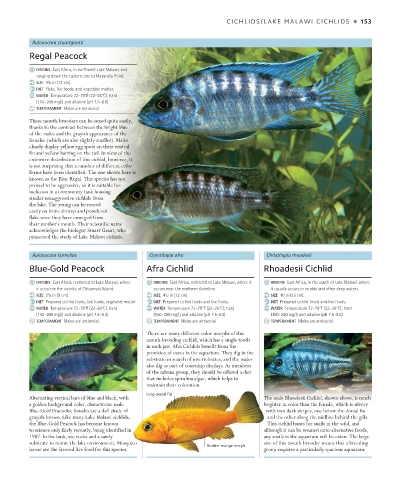
          Aulonocara stuartgranti
         Regal Peacock

           ORIGINS  East Africa, in northwest Lake Malawi, and
           ranging down the eastern side to Makanjila Point.
           SIZE  4 ⁄4 in (12 cm).
              3
           DIET  Flake, live foods, and vegetable matter.
           WATER  Temperature 72–79°F (22–26°C); hard
           (150–200 mg/l) and alkaline (pH 7.5–8.0).
           TEMPERAMENT  Males are antisocial.
         These mouth-brooders can be sexed quite easily,
         thanks to the contrast between the bright blue
         of the males and the grayish appearance of the
         females (which are also slightly smaller). Males
         clearly display yellow egg spots on their ventral
         fin and yellow barring on the tail. In view of the
         extensive distribution of this cichlid, however, it
         is not surprising that a number of different color
         forms have been identified. The one shown here is
         known as the Blue Regal. This species has not
         proved to be aggressive, so it is suitable for
         inclusion in a community tank housing
         similar nonaggressive cichlids from
         the lake. The young can be reared
         easily on brine shrimp and powdered
         flake once they have emerged from
         their mother’s mouth. Their scientific name
         acknowledges the biologist Stuart Grant, who
         pioneered the study of Lake Malawi cichlids.

          Aulonocara korneliae            Cynotilapia afra                Chilotilapia rhoadesii
         Blue-Gold Peacock               Afra Cichlid                     Rhoadesii Cichlid

           ORIGINS  East Africa, restricted to Lake Malawi, where    ORIGINS  East Africa, restricted to Lake Malawi, where it   ORIGINS  East Africa, in the south of Lake Malawi, where
           it occurs in the vicinity of Chisumulu Island.  occurs near the northern shoreline.  it usually occurs in muddy and often deep waters.
           SIZE  3 ⁄4 in (9 cm).           SIZE  4 ⁄2 in (12 cm).           SIZE  10 in (25 cm).
              3
                                               1
           DIET  Prepared cichlid foods, live foods, vegetable matter.  DIET  Prepared cichlid foods and live foods.  DIET  Prepared cichlid foods and live foods.
           WATER  Temperature 72–79°F (22–26°C); hard    WATER  Temperature 72–79°F (22–26°C); hard    WATER  Temperature 72–79°F (22–26°C); hard
           (150–200 mg/l) and alkaline (pH 7.5–8.0).   (150–200 mg/l) and alkaline (pH 7.5–8.0).   (150–200 mg/l) and alkaline (pH 7.5–8.0).
           TEMPERAMENT  Males are antisocial.  TEMPERAMENT  Males are antisocial.  TEMPERAMENT  Males are antisocial.
                                         There are many different color morphs of this
                                         mouth-brooding cichlid, which has a single tooth
                                         in each jaw. Afra Cichlids benefit from the
                                         provision of caves in the aquarium. They dig in the
                                         substrate in search of invertebrates, and the males
                                         also dig as part of courtship displays. As members
                                         of the mbuna group, they should be offered a diet
                                         that includes spirulina algae, which helps to
                                         maintain their coloration.
                                         Long dorsal fin
         Alternating vertical bars of blue and black, with                The male Rhoadesii Cichlid, shown above, is much
         a golden background color, characterize male                     brighter in color than the female, which is silvery
         Blue-Gold Peacocks; females are a dull shade of                  with two dark stripes, one below the dorsal fin
         grayish-brown. Like many Lake Malawi cichlids,                    and the other along the midline behind the gills.
         the Blue-Gold Peacock has become known                            This cichlid hunts for snails in the wild, and
         to science only fairly recently, being identified in             although it can be weaned onto alternative foods,
         1987. In the tank, use rocks and a sandy                         any snails in the aquarium will be eaten. The large
         substrate to mimic the lake environment. Mosquito   Golden-orange morph  size of this mouth-brooder means that a breeding
         larvae are the favored live food for this species.               group requires a particularly spacious aquarium.


   US_152-153_Lake_Malawi_3.indd   153                                                               29/08/18   4:09 PM

