


Page 86 - Encyclopedia of Aquarium and Pond Fish, 3rd Edition
P. 86
84    FRESHWATER FISH DIRECTORY


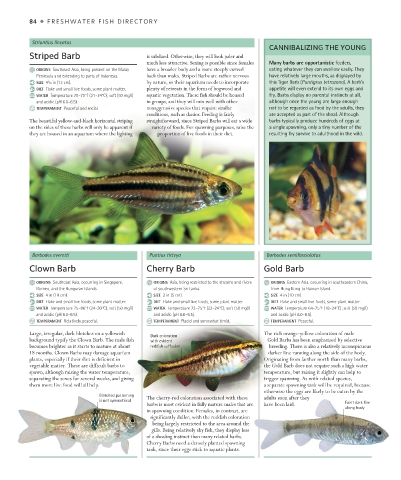
          Striuntius lineatus
                                                                           CANNIBALIZING THE YOUNG
         Striped Barb                    is subdued. Otherwise, they will look paler and
                                         much less attractive. Sexing is possible since females   Many barbs are opportunistic feeders,
           ORIGINS  Southeast Asia, being present on the Malay   have a broader body and a more steeply curved   eating whatever they can swallow easily. They
           Peninsula and extending to parts of Indonesia.  back than males. Striped Barbs are rather nervous   have relatively large mouths, as displayed by
           SIZE  4 ⁄4 in (12 cm).        by nature, so their aquarium needs to incorporate   this Tiger Barb (Puntigrus tetrazona). A barb’s
              3
           DIET  Flake and small live foods, some plant matter.  plenty of retreats in the form of bogwood and   appetite will even extend to its own eggs and
           WATER  Temperature 70–75°F (21–24°C); soft (50 mg/l)   aquatic vegetation. These fish should be housed    fry. Barbs display no parental instincts at all,
           and acidic (pH 6.0–6.5).      in groups, and they will mix well with other   although once the young are large enough
           TEMPERAMENT  Peaceful and social.  nonaggressive species that require similar   not to be regarded as food by the adults, they
                                         conditions, such as danios. Feeding is fairly   are accepted as part of the shoal. Although
         The beautiful yellow-and-black horizontal striping   straightforward, since Striped Barbs will eat a wide   barbs typically produce hundreds of eggs at
         on the sides of these barbs will only be apparent if   variety of foods. For spawning purposes, raise the   a single spawning, only a tiny number of the
         they are housed in an aquarium where the lighting   proportion of live foods in their diet.  resulting fry survive to adulthood in the wild.


          Barbodes everetti               Puntius titteya                 Barbodes semifasciolatus
         Clown Barb                      Cherry Barb                      Gold Barb

           ORIGINS  Southeast Asia, occurring in Singapore,   ORIGINS  Asia, being restricted to the streams and rivers   ORIGINS  Eastern Asia, occurring in southeastern China,
           Borneo, and the Bunguran Islands.  of southwestern Sri Lanka.    from Hong Kong to Hainan Island.
           SIZE  4 in (10 cm).             SIZE  2 in (5 cm).               SIZE  4 in (10 cm).
           DIET  Flake and small live foods, some plant matter.  DIET  Flake and small live foods, some plant matter.  DIET  Flake and small live foods, some plant matter.
           WATER  Temperature 75–86°F (24–30°C); soft (50 mg/l)   WATER  Temperature 72–75°F (22–24°C); soft (50 mg/l)   WATER  Temperature 64–75°F (18–24°C); soft (50 mg/l)
           and acidic (pH 6.0–6.5).        and acidic (pH 6.0–6.5).         and acidic (pH 6.0–6.5).
           TEMPERAMENT  Relatively peaceful.  TEMPERAMENT  Placid and somewhat timid.  TEMPERAMENT  Peaceful.
         Large, irregular, dark blotches on a yellowish   Dark coloration   The rich orange-yellow coloration of male
         background typify the Clown Barb. The male fish   with evident    Gold Barbs has been emphasized by selective
         becomes brighter as it starts to mature at about     reddish suffusion  breeding. There is also a relatively inconspicuous
         18 months. Clown Barbs may damage aquarium                        darker line running along the side of the body.
         plants, especially if their diet is deficient in                 Originating from farther north than many barbs,
         vegetable matter. These are difficult barbs to                   the Gold Barb does not require such a high water
         spawn, although raising the water temperature,                   temperature, but raising it slightly can help to
         separating the sexes for several weeks, and giving               trigger spawning. As with related species,
         them more live food will all help.                               a separate spawning tank will be required, because
                                                                          otherwise the eggs are likely to be eaten by the
                            Blotched patterning
                            is not symmetrical  The cherry-red coloration associated with these   adults soon after they
                                         barbs is most evident in fully mature males that are   have been laid.  Faint dark line
                                         in spawning condition. Females, in contrast, are       along body
                                          significantly duller, with the reddish coloration
                                           being largely restricted to the area around the
                                           gills. Being relatively shy fish, they display less
                                         of a shoaling instinct than many related barbs.
                                         Cherry Barbs need a densely planted spawning
                                         tank, since their eggs stick to aquatic plants.


   US_084-085_Barbs2.indd   84                                                                       29/08/18   4:09 PM

