


Page 101 - The Book of Caterpillars: A Life-Size Guide to Six Hundred Species From Around the World
P. 101
BUTTERFLY CATERPILLARS
FAMILY Hesperiidae
DISTRIBUTION Western North America, from British Columbia to
Baja California, and east to Colorado
HABITAT Most grassy areas, including forest roadsides, meadows, yards,
and shrub-steppes, from sea level to 8,200 ft (2,500 m) elevation
HOST PLANTS Grasses, including Bermuda Grass (Cynodon dactylon),
Common Wild Oat (Avena fatua), and Bluebunch Wheatgrass
(Pseudoroegneria spicta)
NOTE Night-feeding caterpillar that lives in concealed grass-blade nests
CONSERVATION STATUS Not evaluated, but usually common throughout its range
ADULT WINGSPAN
1–1⁄ in (25–30 mm)
CATERPILLAR LENGTH
¾–1 in (20–25 mm)
OCHLODES SYLVANOIDES
WOODLAND SKIPPER 99
(BOISDUVAL, 1852)
Woodland Skipper caterpillars hatch after seven to ten days
from eggs laid singly on the underside of dead grass blades.
They consume their eggshells and, without further feeding,
construct overwintering shelters by tying the edges of a grass
blade together with silk strands. In the spring, the larvae take
five weeks to develop to the final instar, which then lasts about
another month. Feeding caterpillars build nests by pulling
together the edges of a grass blade and tying it into a tube,
forcibly expelling frass to confuse predators. Larvae leave their
nest at night to feed on its tip and sides.
Pupation occurs in a newly tied, grass-blade nest containing
much flocculent material. Here, the pupa hangs with its
ventral side upward, attached to the nest top by a silk thread
and cremaster. Adult Woodland Skippers can be abundant,
sometimes seen in their hundreds visiting late season nectar
sources such as rabbitbrush (Ericameria spp., Chrysothamnus
spp.) and knapweed (Centaurea spp.).
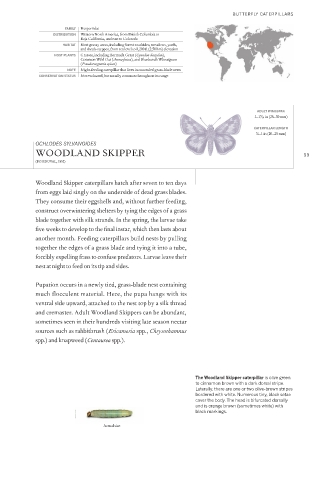
The Woodland Skipper caterpillar is olive green
to cinnamon brown with a dark dorsal stripe.
Laterally, there are one or two olive-brown stripes
bordered with white. Numerous tiny, black setae
cover the body. The head is bifurcated dorsally
and is orange brown (sometimes white) with
black markings.
Actual size

