


Page 102 - The Book of Caterpillars: A Life-Size Guide to Six Hundred Species From Around the World
P. 102
BUTTERFLY CATERPILLARS
FAMILY Hesperiidae
DISTRIBUTION Southeastern Australia, including northwest Tasmania
HABITAT Generally open woodland in alpine environments at 3,300–5,250 ft
(1,000–1,600 m) elevation, but near sea level in Tasmania
HOST PLANTS Tall Sedge (Carex appressa) and occasionally other Carex spp.
NOTE Caterpillar that overwinters in a leaf shelter, sometimes
under snow
CONSERVATION STATUS Not evaluated, but vulnerable in Tasmania, although locally
common on the mainland
ADULT WINGSPAN
1–1⁄ in (25–30 mm)
CATERPILLAR LENGTH
1⁄ in (30 mm)
OREISPLANUS MUNIONGA
ALPINE SEDGE-SKIPPER
100
(OLLIFF, 1890)
The Alpine Sedge-skipper caterpillar hatches from an egg
laid singly on the underside of a host plant leaf. It constructs a
cylindrical shelter by joining several leaf tips together with silk,
leaving the shelter open at the top. When it outgrows the first
shelter, it rebuilds. The caterpillar develops slowly during the
fall to early summer, when conditions are cool and the plants
may be under snow. Feeding occurs at night on leaves above the
Actual size shelter, and the larva rests in the shelter during the day. Pupation
occurs in early summer in the final shelter, which is usually lower
in the sedge clump. There is only one generation a year.
Oreisplanus munionga caterpillars suffer heavy parasitism, with
a large, orange ichneumonid wasp emerging from many pupae.
Adults fly close to their food plants and breed in areas where
the plant density is high. The species belongs to a subfamily
of skipper butterflies (Trapezitinae) that is restricted to the
Australian region. There are two species in the genus, both of
which occur in temperate areas.
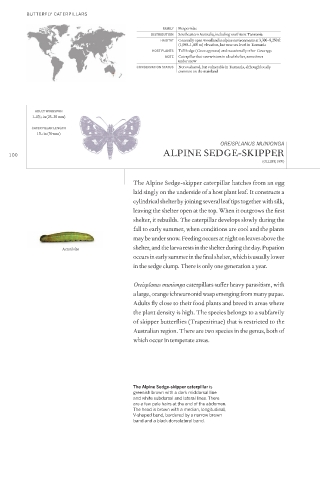
The Alpine Sedge-skipper caterpillar is
greenish brown with a dark middorsal line
and white subdorsal and lateral lines. There
are a few pale hairs at the end of the abdomen.
The head is brown with a median, longitudinal,
V-shaped band, bordered by a narrow brown
band and a black dorsolateral band.

