


Page 106 - The Book of Caterpillars: A Life-Size Guide to Six Hundred Species From Around the World
P. 106
BUTTERFLY CATERPILLARS
FAMILY Hesperiidae
DISTRIBUTION Western United States (Washington State, Oregon,
and California)
HABITAT Coastal prairies, pine savannahs, woodland openings,
and heath meadows
HOST PLANTS Grasses, including Idaho Fescue (Festuca idahoensis), Red Fescue
(Festuca rubra), and California Oatgrass (Danthonia californica)
NOTE Nest-building, night-feeding caterpillar
CONSERVATION STATUS Not evaluated, but when assessed for the US Endangered Species
Act was judged to be potentially threatened, though secure within
occupied habitats
ADULT WINGSPAN
¾–1 in (20–25 mm)
CATERPILLAR LENGTH
⁄–1 in (21–25 mm)
POLITES MARDON
MARDON SKIPPER
104
(W. H. EDWARDS, 1881)
Mardon Skipper caterpillars hatch from eggs laid singly at the
base of grasses. They develop quickly, pupating five to six weeks
after egg hatch. Early instars eat through grass blades partially
from the side, while later instars eat through the tender grass
tips, causing much of the blade to drop to the ground. Nests are
untidy, vertical shelters created by silking blades together, and
caterpillars leave them at night to feed. Frass is stored within
shelters—possibly to conceal it from predators. Prepupal larvae
construct a stronger, final shelter, typically horizontal and near
the ground, for pupation. Overwintering occurs either as
caterpillar or pupa.
Actual size The Mardon Skipper was recently considered for endangered
species listing but subsequently found to be secure in its occupied
habitats. Adults fly low to the ground, feeding on flowers such
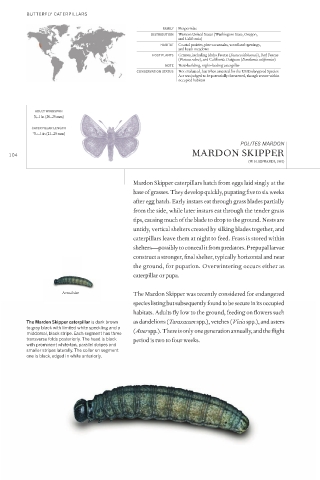
The Mardon Skipper caterpillar is dark brown as dandelions (Taraxacum spp.), vetches (Vicia spp.), and asters
to gray black with limited white speckling and a (Aster spp.). There is only one generation annually, and the flight
middorsal, black stripe. Each segment has three
transverse folds posteriorly. The head is black period is two to four weeks.
with prominent white-tan, parallel stripes and
smaller stripes laterally. The collar on segment
one is black, edged in white anteriorly.

