


Page 103 - The Book of Caterpillars: A Life-Size Guide to Six Hundred Species From Around the World
P. 103
BUTTERFLY CATERPILLARS
FAMILY Hesperiidae
DISTRIBUTION Across Africa, the Middle East, Greece (Rhodes and Kos),
southwest Turkey, and into northwest India
HABITAT Damp forests and forest edges, wetlands, parks,
and occasionally grasslands
HOST PLANTS Imperata arundinacea, Ehrharta erecta, and Panicum miliaceum
NOTE Green caterpillar that lives its life in a leaf tube
CONSERVATION STATUS Not evaluated
ADULT WINGSPAN
1⁄ in (40 mm)
CATERPILLAR LENGTH
1⅜–1⁄ (35–40 mm)
PELOPIDAS THRAX
MILLET SKIPPER 101
(HÜBNER, [1821])
Millet Skipper caterpillars hatch from round eggs laid singly
on leaves by the female butterfly. The young caterpillars each
construct a shelter from a single leaf, rolling the edges into a
tube held in place by silk. They feed on one edge of the leaf and
make a new roll as they run out of food. As they develop, the
larvae use several leaves for their tube shelters. The caterpillars
develop through six instars and then pupate within the leaf tube.
Actual size
In parts of the species’ range there are two generations. The first
is on the wing from June to July and the second from September
to October, although in tropical Africa the Millet Skipper, also
know as the White-branded Swift, is seen for much of the year.
The adult is a fast-flying butterfly seen around flowers and
puddles, with aggressive males that hilltop and may defend their
territories. The species is known to migrate. The genus Pelopidas
comprises ten species, mostly found in Africa and South Asia.
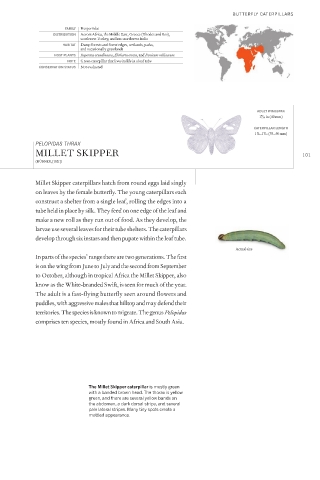
The Millet Skipper caterpillar is mostly green
with a banded brown head. The thorax is yellow
green, and there are several yellow bands on
the abdomen, a dark dorsal stripe, and several
pale lateral stripes. Many tiny spots create a
mottled appearance.

