


Page 99 - The Book of Caterpillars: A Life-Size Guide to Six Hundred Species From Around the World
P. 99
BUTTERFLY CATERPILLARS
FAMILY Hesperiidae
DISTRIBUTION Eastern Australia
HABITAT Rain forests and open eucalypt forests, both on the coast and
in nearby mountains
HOST PLANTS More than 20 species from eight families, commonly Kurrajong
(Brachychiton populneus) and Butterwood (Callicoma serratifolia)
NOTE Caterpillar that, when young, can remain dormant for
many months
CONSERVATION STATUS Not evaluated, but common throughout much of its range
ADULT WINGSPAN
1⁄ –1⅝ in (39–41 mm)
CATERPILLAR LENGTH
1¼ in (32 mm)
NETROCORYNE REPANDA
BRONZE FLAT 97
FELDER & FELDER, [1867]
Bronze Flat caterpillars hatch from eggs that are laid singly,
generally on the upper surface of the new season’s larger leaves.
These larvae construct a shelter on the upper surface of the
leaf by upending and hinging a circular disk cut from the edge
of the leaf. The caterpillar secures the disk with silk and may Actual size
remain inactive for months. Feeding on leaves begins at night
during the spring. Larger caterpillars form twisted cylindrical
shelters out of single leaves, the shelter having a distinctive
exit hole at the top.
The larva pupates within this shelter. The leaf forming the
shelter dies, but the base of the petiole is fastened to the twig
with silk, preventing the shelter containing the pupa from
falling. In the cooler southern parts of the range there is only
one generation a year, but the generation time is variable, even
in warmer regions. The adult butterflies fly fast and rest on sunlit
foliage with their wings spread fully out.
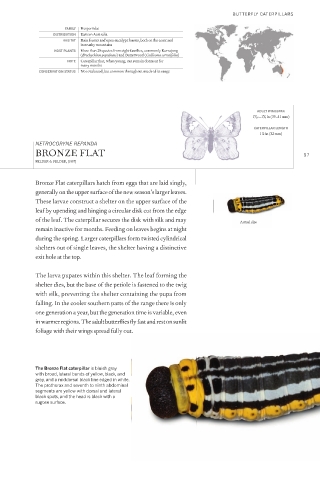
The Bronze Flat caterpillar is bluish gray
with broad, lateral bands of yellow, black, and
gray, and a middorsal black line edged in white.
The prothorax and seventh to ninth abdominal
segments are yellow with dorsal and lateral
black spots, and the head is black with a
rugose surface.

