


Page 97 - The Book of Caterpillars: A Life-Size Guide to Six Hundred Species From Around the World
P. 97
BUTTERFLY CATERPILLARS

                      FAMILY  Hesperiidae
                    TRIBUTION
                  DISTRIBUTION  Scattered areas in southern Australia
                  DIS
                  DISTRIBUTION
                     HABITAT
                        A
                     HABITAT T  Low rainfall, open eucalyptus woodlands with a heath understory
                     HABIT
                  HOST PLANTS S  Mainly sword-sedges (Lepidosperma spp.)
                    T PLANT
                  HOS
                  HOST PLANTS
                      NOTE
                        TE
                      NOTE  Caterpillar that constructs tubular shelters from many leaves
                      NO
             CONSERV A TION S T A TUS  Not evaluated, but localized and generally uncommon
             CONSERVATION STATUS
             CONSERVATION STATUS
                                                                                   ADULT WINGSPAN


                                                                                    1⅜ in (35 mm)
                                                                                  CATERPILLAR LENGTH
                                                                                    1¾ in (44 mm)
            MOTASINGHA TRIMACULATA
            LARGE BROWN SKIPPER                                                                   95
            (TEPPER, 1882)

            The Large Brown Skipper caterpillar hatches from an egg
            laid singly on its food plant in late spring and early summer.
            It constructs a vertical shelter by joining and twisting 20 or
            more of the needlelike Lepidosperma leaves with silk. The
            shelter is open at the top, and the caterpillar rests in the shelter
            during the day, emerging at night to feed on tips of the foliage.
            New shelters are built as the caterpillar grows. On young          Actual size
            plants, the shelter is close to the ground, but on larger clumps
            of the sedge it is midway up the plant. There is only one
            generation a year.


            The caterpillar overwinters and completes growth by late

            winter to mid-spring, then pupates in the final shelter, the head
            orientated upward. Adults fly in the warmer months of spring

            and summer, and the males exhibit strong hilltopping behavior
            where they set up mating territories. The entire subfamily to
            which this species belongs is restricted to the Australian faunal
            region. The genus Motasingha contains two species, both
            confined to southern or western areas of Australia.


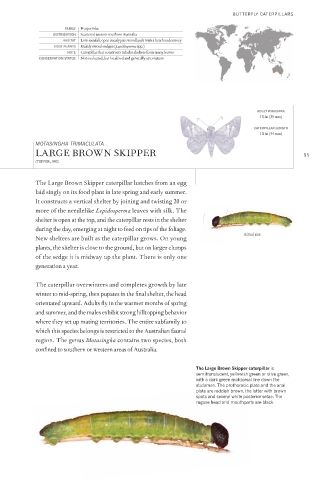
                                                                The Large Brown Skipper caterpillar is
                                                                semitranslucent, yellowish green or olive green,
                                                                with a dark green middorsal line down the
                                                                abdomen. The prothoracic plate and the anal
                                                                plate are reddish brown, the latter with brown
                                                                spots and several white posterior setae. The
                                                                rugose head and mouthparts are black.

