


Page 98 - The Book of Caterpillars: A Life-Size Guide to Six Hundred Species From Around the World
P. 98
BUTTERFLY CATERPILLARS
FAMILY Hesperiidae
DISTRIBUTION North Africa, southern Europe, and eastern Europe
HABITAT Hot, dry meadows and stony grasslands, and Mediterranean
maquis and garrigue scrubland up to 5,250 ft (1,600 m) elevation
HOST PLANTS Phlomis spp.
NOTE Caterpillar that rests in leaf shelters to avoid extreme heat
CONSERVATION STATUS Not evaluated, but in decline due to loss of habitat
ADULT WINGSPAN
⅞–1⅓ in (22–26 mm)
CATERPILLAR LENGTH
⁄–¾ in (15–20 mm)
MUSCHAMPIA PROTO
LARGE GRIZZLED SKIPPER
96
(OCHSENHEIMER, 1816)
Large Grizzled Skipper females lay their eggs near the base of
the host plant and sometimes on stones close by. Unusually for
skippers the egg overwinters, and the caterpillars hatch and
feed the following spring, building leaf-and-silk shelters near
the tips of shoots of the host plant. Although some pupate in
Actual size
early summer, many mature larvae, to avoid the hottest months
of the year, spin a protective cocoon between host plant leaves
a short distance above the ground and rest within it for an
extended period before pupating. This strategy is known as
prepupal dormancy.
As a result, the butterflies may be on the wing at various times
from April to October. Early fl iers are often the only species
active during the summer heat. There is one generation annually.
The Large Grizzled Skipper, also known as the Sage Skipper,
is declining due to loss of its dry habitat through development
and loss of traditional patterns of farming and land management.
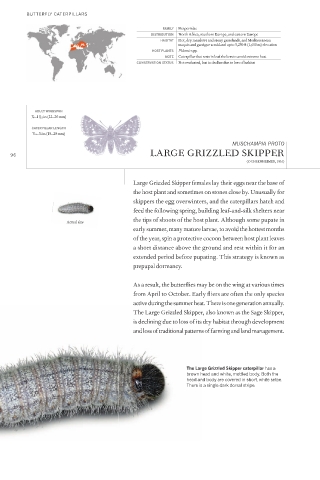
The Large Grizzled Skipper caterpillar has a
brown head and white, mottled body. Both the
head and body are covered in short, white setae.
There is a single dark dorsal stripe.

