


Page 104 - The Book of Caterpillars: A Life-Size Guide to Six Hundred Species From Around the World
P. 104
BUTTERFLY CATERPILLARS
FAMILY Hesperiidae
DISTRIBUTION Southern Canada, United States, and Mexico
HABITAT Watercourses, parks, shrub-steppe, waste ground, and field edges
HOST PLANTS Lambsquarters (Chenopodium album), Russian Thistle
(Salsola kali), and pigweed (Amaranthus spp.)
NOTE Caterpillar that feeds and builds nests on common garden weeds
CONSERVATION STATUS Not evaluated, but usually common
ADULT WINGSPAN
1–1⁄ in (25–30 mm)
CATERPILLAR LENGTH
¾–1 in (20–25 mm)
PHOLISORA CATULLUS
COMMON SOOTYWING
102
(FABRICIUS, 1793)
Common Sootywing adult females lay well-camouflaged eggs
singly, usually on the upperside of an older, mid-sized leaf.
Caterpillars hatch five to six days later, and development to
pupation takes only 22 days with about four days in each instar.
The larvae rest in the upper new growth of host plants, in nests
built by cutting a leaf inward in two places, then folding the loose
flap over and silking it in place along the margin. Older instars
bend entire leaves inward, toward the midvein, fastening them
in place with silk.
The larvae feed nocturnally on leaf edges away from the shelter,
and plant leaves near nests show considerable feeding damage.
Older instars shoot frass to deter predators. The final instar
overwinters, with pupation taking place in spring. In the north
of the species range, there are two generations a year with adults
flying from April to September. In the south, breeding and flight
continue year-round.
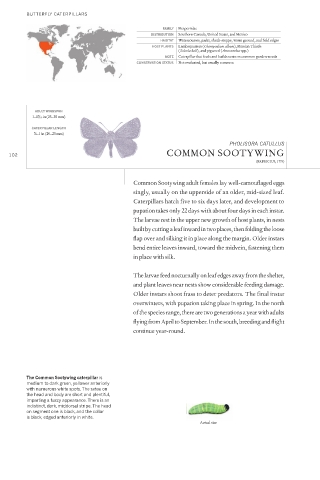
The Common Sootywing caterpillar is
medium to dark green, yellower anteriorly
with numerous white spots. The setae on
the head and body are short and plentiful,
imparting a fuzzy appearance. There is an
indistinct, dark, middorsal stripe. The head
on segment one is black, and the collar
is black, edged anteriorly in white.
Actual size

