


Page 96 - The Book of Caterpillars: A Life-Size Guide to Six Hundred Species From Around the World
P. 96
BUTTERFLY CATERPILLARS

                                                     FAMILY  Hesperiidae
                                                 DISTRIBUTION
                                                 DISTRIBUTION
                                                 DIS TRIBUTION  Eastern Australia
                                                    HABITAT
                                                    HABIT
                                                       A
                                                    HABITAT T  Moist coastal heathlands with sandy soils
                                                    T PLANT
                                                  HOST PLANTS S  Native iris (Patersonia spp.)
                                                  HOST PLANTS
                                                  HOS
                                                       TE
                                                      NOTE
                                                      NOTE  Caterpillar that is covered in white, waxy powder
                                                      NO
                                             CONSERVATION STATUS
                                             CONSERV A TION S T A TUS  Not evaluated, but can be locally common
                                             CONSERVATION STATUS
            ADULT WINGSPAN
             1¼ in (32 mm)
           CATERPILLAR LENGTH
             1 in (25 mm)
                                                                             MESODINA HALYZIA
                                                       EASTERN IRIS-SKIPPER
    94
                                                                                  (HEWITSON, 1868)


                                            The Eastern Iris-skipper caterpillar hatches from an egg laid
                                            singly on the host plant. It builds an elaborate, cylindrical
                                            shelter using silk and three or more leaves from the plant. The
                                            leaves are drawn together into a vertical position and bound
                                            and heavily lined with silk—a process that can take several
                                            days. Larger shelters are constructed as the caterpillar grows.
                     Actual size
                                            It rests in the shelter, head down during the day, then emerges
                                            from the opening at the bottom of the shelter at dusk to feed
                                            on the nearby foliage. The characteristic V-shaped notch in the
                                            leaves indicates the presence of the caterpillar. There is probably
                                            only one generation a year in the south of the range but two
                                            in northern areas.


                                            Generally, there is only one caterpillar per plant. Pupation
                                            occurs in the final shelter, the pupa suspended head down and

                                            attached by the cremaster to the silk-lined shelter. Adults feed
                                            at flowers but generally stay close to their breeding areas. The


                                            genus contains five species, all endemic to Australia and all using
                                            Patersonia species as food plants.


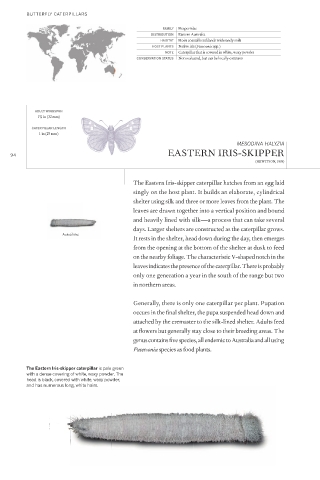
         The Eastern Iris-skipper caterpillar is pale green
         with a dense covering of white, waxy powder. The
         head is black, covered with white, waxy powder,
         and has numerous long, white hairs.

