


Page 105 - The Book of Caterpillars: A Life-Size Guide to Six Hundred Species From Around the World
P. 105
BUTTERFLY CATERPILLARS

                      FAMILY  Hesperiidae
                  DISTRIBUTION  Southern Rocky Mountains, south to western Mexico
                     HABITAT  Mountain valley bottoms
                  HOST PLANTS  Hay grasses (tall, wide-leafed grasses, such as Dactylis spp.
                           and Poa spp.)
                      NOTE  Caterpillars that build silked tube nests in grasses
             CONSERVATION STATUS  Not evaluated, but common in most of its range


                                                                                   ADULT WINGSPAN
                                                                                  1¼–1¹¹∕₁₆ in (32–43 mm)
                                                                                  CATERPILLAR LENGTH
                                                                                    1³∕₁₆ in (30 mm)
            POANES TAXILES
            TAXILES SKIPPER                                                                      103

            (W. H. EDWARDS, 1881)


            The Taxiles Skipper caterpillar eats any of several dozen species
            of tall, skinny, wide-leaf grasses mostly growing at the bottom of
            valleys—the kinds of grasses farmers grow for hay. The larva
            attaches silk threads on each side of the top of a wide leaf, and
            each thread shrinks and makes the leaf curl. When the leaf is
            curled into a tube, the edges are silked shut to create a leaf-tube
            nest where the caterpillar rests when not feeding. Half-grown
            caterpillars hibernate in a silk nest, develop further in the spring,
            and then pupate in another silked-leaf nest.


            Like other grass-feeding skippers, and also satyrids (Satyrinae),
            the caterpillar has mandibles without teeth (like scissor blades)
            to cut through tough grass leaves; other species have toothed
            mandibles to saw through leaves. A single generation of adults
            emerges in early summer. The adults, named for their darting
            flight, are avid flower visitors commonly found near moist oases


            at the bottom of desert canyons. There are more than 3,500
            skipper species worldwide.


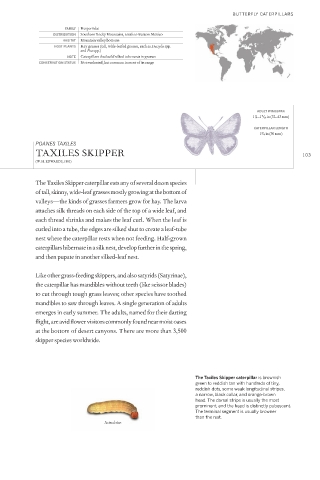
                                                               The Taxiles Skipper caterpillar is brownish
                                                               green to reddish tan with hundreds of tiny,
                                                               reddish dots, some weak longitudinal stripes,
                                                               a narrow, black collar, and orange-brown
                                                               head. The dorsal stripe is usually the most
                                                               prominent, and the head is distinctly pubescent.
                                                               The terminal segment is usually browner
                                                               than the rest.
                                  Actual size

