


Page 107 - The Book of Caterpillars: A Life-Size Guide to Six Hundred Species From Around the World
P. 107
BUTTERFLY CATERPILLARS
FAMILY Hesperiidae
DISTRIBUTION Areas of North America, northern Europe, and northern Asia
HABITAT Alpine, mountain tops above the tree line, talus slopes, and also
moist meadows
HOST PLANTS Cinquefoil (Potentilla spp.) and wild strawberry (Fragaria spp.)
NOTE Mountaintop caterpillar taking up to two years to
complete development
CONSERVATION STATUS Not evaluated, but never occurs in large numbers
ADULT WINGSPAN
1–1⁄ in (25–30 mm)
CATERPILLAR LENGTH
⅞–1 in (23–25 mm)
PYRGUS CENTAUREAE
ALPINE GRIZZLED SKIPPER 105
(RAMBUR, [1842])
Adult female Alpine Grizzled Skippers lay eggs singly on the
underside of host plant leaves, where they hatch after nine to ten
days. The first caterpillar instar chews a hole at the top of the egg,
through which it emerges leaving the rest of the shell uneaten.
Caterpillars build folded-leaf nests throughout development,
in which they remain except when feeding on adjacent leaves,
mostly by night, always returning to shelters. They eject frass
from nests, presumably to help divert predators, although pirate
bugs (Anthocoridae) seem not to be duped by this ploy and
likely take a significant number of larvae.
In some locations, complete development of the species may
last two years. In captivity, development from the second to Actual size
the fifth instar takes about six weeks, with growth in the fifth
instar slowing and pupation occurring about a month later.
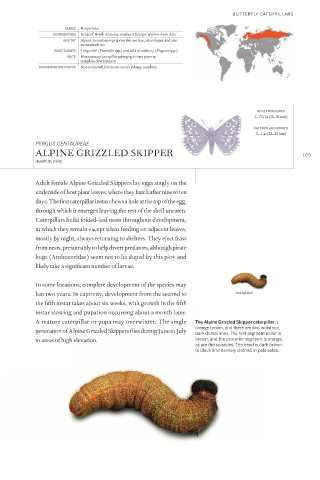
A mature caterpillar or pupa may overwinter. The single The Alpine Grizzled Skipper caterpillar is
generation of Alpine Grizzled Skippers flies during June to July orange brown, and there are two indistinct,
dark dorsal lines. The rst segment collar is
in areas of high elevation. brown, and the posterior segment is orange,
as are the spiracles. The head is dark brown
to black and densely clothed in pale setae.

