


Page 108 - The Book of Caterpillars: A Life-Size Guide to Six Hundred Species From Around the World
P. 108
BUTTERFLY CATERPILLARS
FAMILY Hesperiidae
DISTRIBUTION Europe, from southern and central England, east into Turkey
and Russia; also Mongolia, northeast China, and Japan
HABITAT Chalk grassland, open woodlands with glades and tracks,
cuttings and embankments, and derelict quarries
HOST PLANTS Rosaceae, including Agrimonia spp., Alchemilla spp.,
and Potentilla spp.
NOTE Greenish caterpillar that feeds and rests within its leaf shelter
CONSERVATION STATUS Not evaluated, but experiencing population decline in some
parts of its range
ADULT WINGSPAN
1–1⅛ in (25–28 mm)
CATERPILLAR LENGTH
⁄ in (18 mm)
PYRGUS MALVAE
GRIZZLED SKIPPER
106
(LINNAEUS, 1758)
Grizzled Skipper caterpillars hatch from dome-shaped eggs laid
singly on the underside of leaves of the host plant. The young
larva spins a thin silken web over the upper surface of leaves in
which it shelters and feeds. The older caterpillar, which rests
much of the time, lives within a folded leaf that is secured in
place by silken threads. It grows relatively slowly, reaching its
final instar after about two months. The larvae pupate near the
base of the plant within a loose cocoon. The pupa overwinters,
and the adult emerges the following spring.
There is usually a single generation on the wing between May
and June, but in good years there may be a second generation
in late summer. Overall, the species is in decline, mostly as a
result of the intensification of farming and the lack of traditional
management techniques such as coppicing and livestock grazing,
which have led to a loss of host plants.
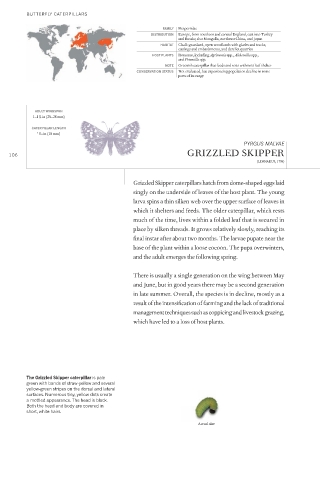
The Grizzled Skipper caterpillar is pale
green with bands of straw-yellow and several
yellow-green stripes on the dorsal and lateral
surfaces. Numerous tiny, yellow dots create
a mottled appearance. The head is black.
Both the head and body are covered in
short, white hairs.
Actual size

