


Page 109 - The Book of Caterpillars: A Life-Size Guide to Six Hundred Species From Around the World
P. 109
BUTTERFLY CATERPILLARS

                      FAMILY  Hesperiidae
                  DISTRIBUTION  The Andes of Colombia, Ecuador, Peru, and Bolivia
                     HABITAT  Humid, mid-elevation cloud forests, forest edges,
                           and regenerating forests
                  HOST PLANTS  Vismia spp.
                      NOTE  Caterpillar with white hairs often stained orange by Vismia sap
             CONSERVATION STATUS  Not evaluated, but not likely to be endangered


                                                                                   ADULT WINGSPAN
                                                                                  2–2³∕₁₆ in (50–56 mm)
                                                                                  CATERPILLAR LENGTH
            PYRRHOPYGE PAPIUS                                                     1⅞–2⅛ in (48–54 mm)
            SHOULDER-STREAKED
            FIRETIP                                                                              107

            HOPFFER, 1874


            The strikingly banded caterpillar of the Shoulder-streaked
            Firetip hides away inside a cleverly crafted leaf shelter while
            not feeding. Small caterpillars carefully excise a manhole-shaped
            circle from the center of a leaf, then feed on the isolated tissue
            of this flap, which enables them to avoid gumming up their
            mandibles with the thick, bright orange latex of their host plant.
            After hatching, the rather slow-growing caterpillars may take as
            long as 110 days before they pupate, their rate of growth likely
            curbed by the compounds they ingest from their chemically
            defended host plant.


            There are around 40 species of fat-bodied, small-winged adult

            fi retips—Pyrrhopyge species—all extremely fast fliers and most
            frequently seen dashing about with an audible buzzing of their
            wings. They descend to the ground to feed at feces, rotting fruit,
            and urine-enriched soils, only rarely visiting flowers. For those

            species with described caterpillars, all are known to build larval
            shelters and have the ability to forcibly expel their frass away
            from their homes.


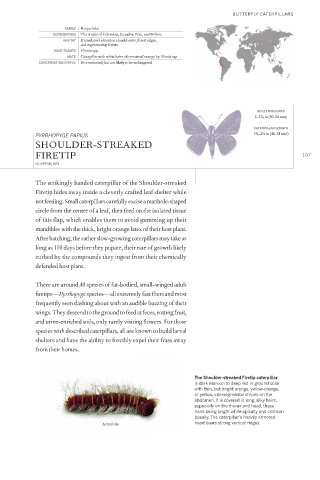
                                                               The Shoulder-streaked Firetip caterpillar
                                                               is dark maroon to deep red in ground color
                                                               with thin, but bright orange, yellow-orange,
                                                               or yellow, intersegmental stripes on the
                                                               abdomen. It is covered in long, silky hairs,
                                                               especially on the thorax and head, these
                                                               hairs being bright white apically and crimson
                                                               basally. The caterpillar’s heavily armored
                                  Actual size                  head bears strong vertical ridges.

