


Page 110 - The Book of Caterpillars: A Life-Size Guide to Six Hundred Species From Around the World
P. 110
BUTTERFLY CATERPILLARS

                                                     FAMILY  Hesperiidae
                                                 DISTRIBUTION  Southwestern United States, south to northern Mexico
                                                    HABITAT  Open pinewoods in lower mountains
                                                  HOST PLANTS  Grasses growing in large clumps, such as needlegrass (Stipa spp.)
                                                          and Side Oats Grama (Bouteloua curtipendula)
                                                      NOTE  Caterpillar that is semitranslucent
                                             CONSERVATION STATUS  Not evaluated, but apparently secure within its range


            ADULT WINGSPAN
           1–1³∕₁₆ in (25–30 mm)
           CATERPILLAR LENGTH
             1³∕₁₆ in (30 mm)
                                                                            STINGA MORRISONI
                                                         MORRISON’S SKIPPER
    108
                                                                                (W. H. EDWARDS, 1878)


                                            Morrison’s Skipper caterpillars live in large clumps of many

                                            kinds of grass, which afford them protection from predators.
                                            Each caterpillar silks several grass leaves together and remains
                                            inside that nest, where its strange, semitranslucent body
                                            attracts no attention. The caterpillar makes larger and larger
                                            vertical nests as it becomes full grown, and then hibernates in a
                                            leaf nest over the winter, pupating in the spring. There is
                                            a single annual generation, except in west Texas, where there
                                            are two generations.
                    Actual size

                                            Adults emerge in May, and males fly to nearby hilltops waiting

                                            for females and the opportunity to mate. Both sexes visit a
                                            variety of flowers for nectar. The butterflies have a silver
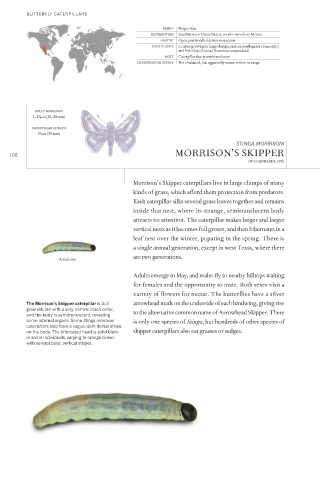
         The Morrison’s Skipper caterpillar is dull   arrowhead mark on the underside of each hindwing, giving rise
         greenish tan with a very narrow, black collar,   to the alternative common name of Arrowhead Skipper. There
         and the body is semitranslucent, revealing
         some internal organs. Some Stinga morrisoni   is only one species of Stinga, but hundreds of other species of
         caterpillars also have a vague, dark dorsal stripe
         on the body. The bifurcated head is solid black   skipper caterpillars also eat grasses or sedges.
         in some individuals, varying to orange brown
         with several paler, vertical stripes.

