


Page 112 - The Book of Caterpillars: A Life-Size Guide to Six Hundred Species From Around the World
P. 112
BUTTERFLY CATERPILLARS
FAMILY Hesperiidae
DISTRIBUTION From Nicaragua south through Colombia and Amazonia to
southern Brazil
HABITAT Humid and semi-humid forests and forest borders, generally
below 2,625 ft (800 m) elevation
HOST PLANTS Inga spp.
NOTE Caterpillar that builds distinctive, triangular, perforated shelters
CONSERVATION STATUS Not evaluated, but not considered threatened
ADULT WINGSPAN
1⁄–1⁄ (30–40 mm)
CATERPILLAR LENGTH
1⁄–2 in (40–50 mm)
TELEMIADES ANTIOPE
PLÖTZ’S TELEMIADES
110
(PLÖTZ, 1882)
Plötz Telemiades caterpillars hatch from eggs laid singly, usually
on fresh leaves of their host and almost always on small seedlings
in the understory. Their shelters are unique, beautiful, and easily
recognized from a distance. Young larvae excise an elongated,
delicate triangle from the leaf margin, flipping it to the top of the
leaf and resting below it. The final shelter is almost invariably
formed at the tip of a leaf and is also roughly triangular, but the
caterpillar creates intricate channels and perforations across its
surface as it develops within.
The mature caterpillar, colored in subtle complementary shades
of blue, orange, and gray, pupates within its final larval shelter,
forming a glossy, red-brown chrysalis. Adults are very fast fliers,
almost invisible to the naked eye when at full speed and only
visible when they land, wings spread wide, on the undersurface
of a leaf. The genus Telemiades contains some 17 species with
a number of subspecies, all in Central and South America.
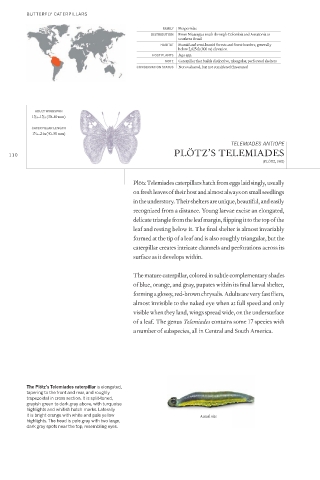
The Plötz’s Telemiades caterpillar is elongated,
tapering to the front and rear, and roughly
trapezoidal in cross section. It is split-toned,
grayish green to dark gray above, with turquoise
highlights and whitish hatch marks. Laterally
it is bright orange with white and pale yellow Actual size
highlights. The head is pale gray with two large,
dark gray spots near the top, resembling eyes.

