


Page 114 - The Book of Caterpillars: A Life-Size Guide to Six Hundred Species From Around the World
P. 114
BUTTERFLY CATERPILLARS

                                                     FAMILY  Hesperiidae
                                                 DISTRIBUTION  North America
                                                    HABITAT  Open woods and brushy areas
                                                  HOST PLANTS  Legumes such as wild pea (Lathyrus spp.) and vetch (Vicia spp.);
                                                          also tick-trefoil (Desmodium spp.), bush clover (Lespedeza spp.),
                                                          clover (Trifolium spp.), and Birdsfoot Trefoil (Lotus corniculatus)
                                                      NOTE  Caterpillar resembling many other species in the large
                                                          skipper family
                                             CONSERVATION STATUS  Not evaluated, but common in North America


            ADULT WINGSPAN
           1¼–1⅞ in (32–47 mm)
           CATERPILLAR LENGTH
             1⅜ in (35 mm)
                                                                            THORYBES PYLADES
                                                NORTHERN CLOUDYWING
    112
                                                                                   (SCUDDER, 1870)


                                            Northern Cloudywing caterpillars, found on numerous legumes,
                                            especially those with tendrils such as the wild pea and vetch,
                                            construct a nest by silking one or more of the host plant leaves
                                            together. The narrow neck of the caterpillar is characteristic
                                            of most Hesperiidae species, allowing them to maneuver the
                                            head to silk the inside of the leaf nest. The caterpillars venture
                                            out to feed on leaves but rest inside most of the time. They have
                                            a comb on the rear that they use to snap their dung far away,
                                            to avoid fouling the nest.

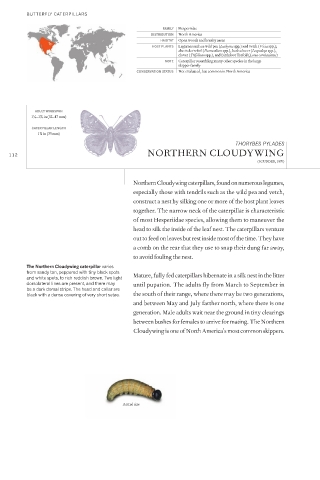
          The Northern Cloudywing caterpillar varies
          from sandy tan, peppered with tiny black spots   Mature, fully fed caterpillars hibernate in a silk nest in the litter
          and white spots, to rich reddish brown. Two light
          dorsolateral lines are present, and there may   until pupation. The adults fly from March to September in
          be a dark dorsal stripe. The head and collar are
          black with a dense covering of very short setae.  the south of their range, where there may be two generations,
                                            and between May and July farther north, where there is one
                                            generation. Male adults wait near the ground in tiny clearings
                                            between bushes for females to arrive for mating. The Northern
                                            Cloudywing is one of North America’s most common skippers.


                                        Actual size

