


Page 115 - The Book of Caterpillars: A Life-Size Guide to Six Hundred Species From Around the World
P. 115
BUTTERFLY CATERPILLARS
FAMILY Hesperiidae
DISTRIBUTION Southern Canada, northern United States, Europe
(including southern United Kingdom and southern
Scandinavia), North Africa, and central Asia
HABITAT Hayfields, meadows, pastures, and grassy waste ground
HOST PLANTS Grasses, including Reed Canary Grass (Phalaris arundinaceae),
Timothy Hay (Phleum pretense), and Orchard Grass
(Dactylis glomerata)
NOTE Night-feeding caterpillar that rests by day in grass nests
CONSERVATION STATUS Not evaluated, but common or abundant in most locations
ADULT WINGSPAN
¾–1 in (20–25 mm)
CATERPILLAR LENGTH
⁄–⅞ in (18–22 mm)
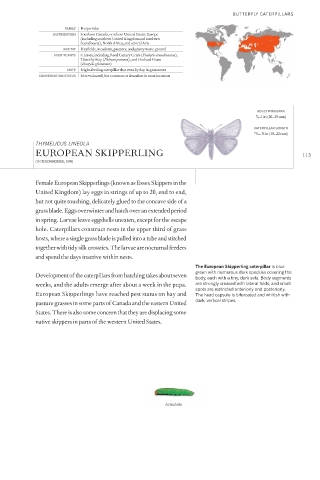
THYMELICUS LINEOLA
EUROPEAN SKIPPERLING 113
(OCHSENHEIMER, 1808)
Female European Skipperlings (known as Essex Skippers in the
United Kingdom) lay eggs in strings of up to 20, end to end,
but not quite touching, delicately glued to the concave side of a
grass blade. Eggs overwinter and hatch over an extended period
in spring. Larvae leave eggshells uneaten, except for the escape
hole. Caterpillars construct nests in the upper third of grass
hosts, where a single grass blade is pulled into a tube and stitched
together with tidy silk crossties. The larvae are nocturnal feeders
and spend the days inactive within nests.
The European Skipperling caterpillar is blue
Development of the caterpillars from hatching takes about seven green with numerous dark speckles covering the
body, each with a tiny, dark seta. Body segments
weeks, and the adults emerge after about a week in the pupa. are strongly creased with lateral folds, and small
European Skipperlings have reached pest status on hay and spots are restricted anteriorly and posteriorly.
The head capsule is bifurcated and whitish with
pasture grasses in some parts of Canada and the eastern United dark, vertical stripes.
States. There is also some concern that they are displacing some
native skippers in parts of the western United States.
Actual size

