


Page 113 - The Book of Caterpillars: A Life-Size Guide to Six Hundred Species From Around the World
P. 113
BUTTERFLY CATERPILLARS
FAMILY Hesperiidae
DISTRIBUTION The Andes of Venezuela, south to Peru
HABITAT Edges of upper subtropical and lower temperate cloud forests
HOST PLANTS Amazonvine (Stigmaphyllon spp.)
NOTE Caterpillar that builds precise, triangular shelters from
host plant leaves
CONSERVATION STATUS Not evaluated, but not considered threatened
ADULT WINGSPAN
1⁄–1⁄ in (37–43 mm)
CATERPILLAR LENGTH
1⁄–1¾ in (40–45 mm)
THEAGENES ALBIPLAGA
MERCURIAL SKIPPER 111
(FELDER & FELDER, [1867])
Mercurial Skipper caterpillars, like many other larvae of the
family Hesperiidae, rest within shelters they build with silk and
portions of their host plant. During early instars, caterpillars of
this species excise a thin strip of leaf from the margin, curling it
over onto the upper surface to create a shelter. As the larvae grow
larger, a new shelter is built as the smaller one is outgrown, each
successive shelter becoming less elongate and more triangular.
The final instars generally sew together the overlapping margins
of adjacent leaves, chewing numerous holes in the walls of the
otherwise completely sealed refuge.
The adults—among the most distinctive and widespread
skippers in South America—are rapid fliers, zipping about
erratically low to the ground and periodically settling to feed
at puddles or moist sand. To date, details of the life cycle and
fascinating shelter-building behavior of the larvae of Theagenes
albiplaga have not been published.
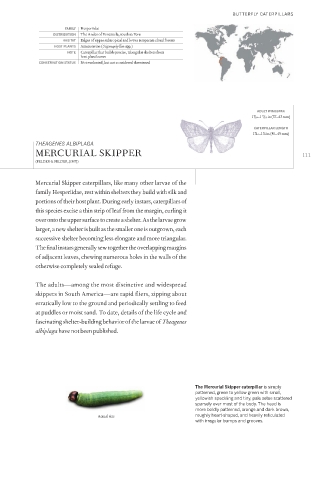
The Mercurial Skipper caterpillar is simply
patterned, green to yellow green with small,
yellowish speckling and tiny, pale setae scattered
sparsely over most of the body. The head is
more boldly patterned, orange and dark brown,
Actual size roughly heart-shaped, and heavily reticulated
with irregular bumps and grooves.

