


Page 111 - The Book of Caterpillars: A Life-Size Guide to Six Hundred Species From Around the World
P. 111
BUTTERFLY CATERPILLARS

                      FAMILY  Hesperiidae
                  DISTRIBUTION  Timor, New Guinea, and northern and eastern Australia
                     HABITAT  Lowland open forests and paperbark woodlands
                  HOST PLANTS  Blady Grass (Imperata cylindrica) and Guinea Grass
                           (Panicum maximum)
                      NOTE  Caterpillar that constructs a shelter from one rolled leaf blade
             CONSERVATION STATUS  Not evaluated, but locally common in northern areas


                                                                                   ADULT WINGSPAN
                                                                                    ⅞ in (22 mm)
                                                                                  CATERPILLAR LENGTH
                                                                                    1 in (25 mm)
            SUNIANA LASCIVIA
            DINGY GRASS-DART                                                                     109

            (ROSENSTOCK, 1885)


            The Dingy Grass-dart caterpillar constructs a shelter from a
            single leaf blade by rolling the edges and joining them with silk.
            This refuge is in the upper part of the leaf, and the larva emerges
            from the bottom of the shelter at night to feed on the leaf below.
            Eventually, the shelter, and the leaf above, are left drooping
            down, with only the uneaten midrib preventing the structure
            from falling. After consuming the shelter, the caterpillar will
            move to another leaf and construct a new one.

                                                                            Actual size

            Pupation occurs in the final larval shelter, or a new construction
            at the base of the plant, but only after the larva has plugged both
            ends of the shelter with silk. There is only one generation a year
            in the south of the range, but the species breeds throughout
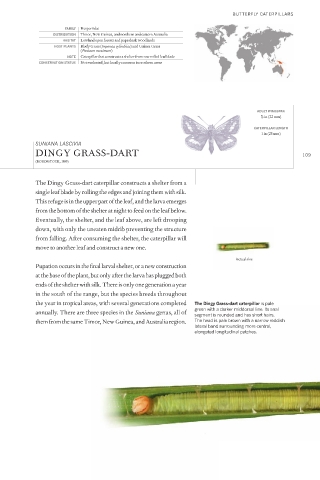
            the year in tropical areas, with several generations completed   The Dingy Grass-dart caterpillar is pale
            annually. There are three species in the Suniana genus, all of   green with a darker middorsal line. Its anal
                                                               segment is rounded and has short hairs.
            them from the same Timor, New Guinea, and Australia region.  The head is pale brown with a narrow reddish
                                                               lateral band surrounding more central,
                                                               elongated longitudinal patches.

