


Page 18 - The Book of Caterpillars: A Life-Size Guide to Six Hundred Species From Around the World
P. 18
FROM EGGS TO PUPATION


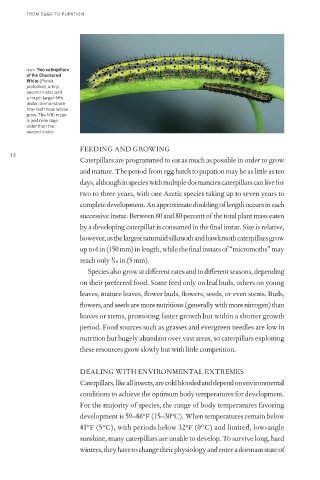
          right Two caterpillars
          of the Checkered
          White (Pontia
          protodice), a tiny
          second instar and
          a much larger fifth
          instar, demonstrate
          how fast these larvae
          grow. The fifth instar
          is just nine days
          older than the
          second instar.

                           FEEDING AND GROWING
    16
    16
                           Caterpillars are programmed to eat as much as possible in order to grow
                           and mature. The period from egg hatch to pupation may be as little as ten
                           days, although in species with multiple dormancies caterpillars can live for

                           two to three years, with one Arctic species taking up to seven years to
                           complete development. An approximate doubling of length occurs in each
                           successive instar. Between 60 and 80 percent of the total plant mass eaten
                           by a developing caterpillar is consumed in the final instar. Size is relative,
                           however, as the largest saturniid silkmoth and hawkmoth caterpillars grow
                           up to 6 in (150 mm) in length, while the final instars of “micromoths” may

                           reach only 3/16 in (5 mm).
                             Species also grow at different rates and in different seasons, depending
                           on their preferred food. Some feed only on leaf buds, others on young
                           leaves, mature leaves, flower buds, flowers, seeds, or even stems. Buds,

                           flowers, and seeds are more nutritious (generally with more nitrogen) than
                           leaves or stems, promoting faster growth but within a shorter growth
                           period. Food sources such as grasses and evergreen needles are low in
                           nutrition but hugely abundant over vast areas, so caterpillars exploiting
                           these resources grow slowly but with little competition.


                           DEALING WITH ENVIRONMENTAL EXTREMES
                           Caterpillars, like all insects, are cold blooded and depend on environmental
                           conditions to achieve the optimum body temperatures for development.

                           For the majority of species, the range of body temperatures favoring
                           development is 59–86ºF (15–30ºC). When temperatures remain below
                           41ºF (5ºC), with periods below 32ºF (0°C) and limited, low-angle
                           sunshine, many caterpillars are unable to develop. To survive long, hard
                           winters, they have to change their physiology and enter a dormant state of

