


Page 142 - The Book of Caterpillars: A Life-Size Guide to Six Hundred Species From Around the World
P. 142
BUTTERFLY CATERPILLARS
FAMILY Riodinidae
W
Western Ecuador
n Ecuado
r
este
DISTRIBUTION
DISTRIBUTION Western Ecuador r
TRIBUTION
DIS
Lower temperate and foothill forests and forest borders
Lower temperate and foothill forests and forest borders
HABIT A T Lo we r temper ate and f oothill forests an d fores t border s
HABITAT
HABITAT
Unknown genera and plants of the family Rubiaceae
Unknown genera and plants of the family Rubiaceae
T PLANT
HOS
HOST PLANTS
HOST PLANTS S Unkno wn g ener a and pla nts of t he f ami ly R ubiace ae
Caterpillar whose coloring provides excellent camoufl
Caterpillar whose coloring provides excellent camouflage
NOTE
TE
NOTE Cater pillar w hose col oring p r o vides ex cellent camoufl age age
NO
against its host plant
again
against its host plant
st its h
ost plant
ned
ed threa
te
but not consider
Not e
Not evaluated, but not considered threatened
valuated,
T
TUS
A
CONSERVATION STATUS Not evaluated, but not considered threatened
TION S
CONSERV
A
CONSERVATION STATUS
ADULT WINGSPAN
1⅛–1⁄ in (29–33 mm)
CATERPILLAR LENGTH
⁄–⅞ in (18–22 mm)
LEUCOCHIMONA AEQUATORIALIS
ECUADORIAN EYEMARK
140
(SEITZ, 1913)
The Ecuadorian Eyemark caterpillar hatches from a minute,
disk-shaped egg laid on areas of new leaf growth. Like
many other members of the family Riodinidae, the larva is
unremarkable in appearance, closely matching the ground color
of leafy portions of its host plant so that it is nearly invisible
when not in motion. Even then, the caterpillar generally moves
so slowly that it remains hard to detect. So far as is known, all
instars share the same appearance and habits, beginning life
feeding on the newest leaf growth and moving to more mature
foliage as later instars.
Adult Ecuadorian Eyemarks are most commonly seen flitting
along the edges of forests in a soft, bouncy flight. They pause
frequently to perch either on the upper or lower surface of leaves,
usually with their wings held partially open but occasionally,
when perched below, with wings fully spread. The species has
not been formally described.
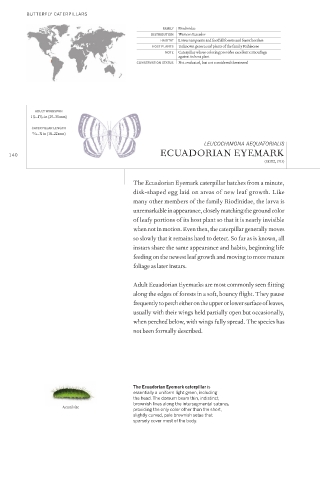
The Ecuadorian Eyemark caterpillar is
essentially a uniform light green, including
the head. The dorsum bears thin, indistinct,
brownish lines along the intersegmental sutures,
Actual size
providing the only color other than the short,
slightly curved, pale brownish setae that
sparsely cover most of the body.

