


Page 146 - The Book of Caterpillars: A Life-Size Guide to Six Hundred Species From Around the World
P. 146
BUTTERFLY CATERPILLARS
FAMILY Lycaenidae
DISTRIBUTION Across Europe, except the northernmost regions, Turkey to
Turkmenistan, and western China
HABITAT Calcareous grasslands, heathlands, and open woodlands
HOST PLANTS Various, including Erodium spp., Helianthemum spp.,
and Geranium spp.
NOTE Caterpillar that has a mutually beneficial relationship with ants
CONSERVATION STATUS Not evaluated, but quite common and widespread
ADULT WINGSPAN
⅞–1⅛ in (22–28 mm)
CATERPILLAR LENGTH
⅜–⁄ in (10–15 mm)
ARICIA AGESTIS
BROWN ARGUS
144
([DENIS & SCHIFFERMÜLLER], 1775)
The female Brown Argus flies close to the ground in search of
host plants on which to oviposit and lays her white eggs singly on
the underside of leaves, close to the midrib. The newly hatched
caterpillars remain on the underside, chewing the leaf, but leave
Actual size the upper surface intact, creating a see-through window. The
species has a mutually beneficial relationship with ants. During
the day, the caterpillars rest and are milked by ants for a sugary
exudate. In return, the ants provide protection from predators
and parasitoids.
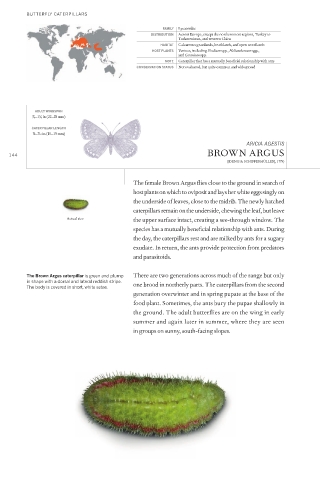
The Brown Argus caterpillar is green and plump There are two generations across much of the range but only
in shape with a dorsal and lateral reddish stripe. one brood in northerly parts. The caterpillars from the second
The body is covered in short, white setae.
generation overwinter and in spring pupate at the base of the
food plant. Sometimes, the ants bury the pupae shallowly in
the ground. The adult butterflies are on the wing in early
summer and again later in summer, where they are seen
in groups on sunny, south-facing slopes.

