


Page 144 - The Book of Caterpillars: A Life-Size Guide to Six Hundred Species From Around the World
P. 144
BUTTERFLY CATERPILLARS

                                                     FAMILY  Riodinidae
                                                   TRIBUTION
                                                 DIS
                                                 DISTRIBUTION  Western Amazon, from Colombia south to Bolivia
                                                 DISTRIBUTION
                                                    HABIT
                                                    HABITAT T  Humid Amazonian forest, especially in tree gaps and at river edges
                                                    HABITAT
                                                       A
                                                  HOST PLANTS
                                                  HOST PLANTS
                                                  HOS T PLANT S  Bauhinia spp.
                                                      NO
                                                      NOTE  Sluglike caterpillar that forms a protective relationship with ants
                                                       TE
                                                      NOTE
                                             CONSERVATION STATUS  Not evaluated, but not considered threatened
                                             CONSERVATION STATUS
                                             CONSERV
                                                     T
                                                  TION S
                                                      A
                                                      TUS
                                                 A
            ADULT WINGSPAN
           1–1⅛ in (26–29 mm)
           CATERPILLAR LENGTH
            ¾–⅞ in (20–23 mm)
                                                                        PROTONYMPHIDIA SENTA
                                                 PROTONYMPHIDIA SENTA
    142
                                                                                  (HEWITSON, 1853)
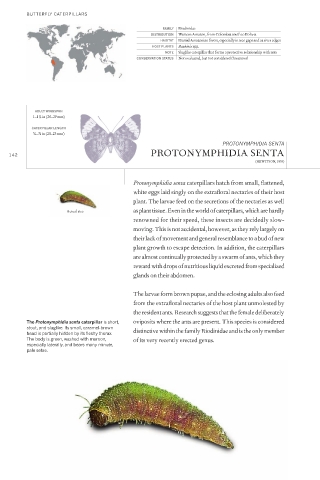
                                            Protonymphidia senta caterpillars hatch from small, flattened,

                                            white eggs laid singly on the extrafloral nectaries of their host

                                            plant. The larvae feed on the secretions of the nectaries as well
                      Actual size           as plant tissue. Even in the world of caterpillars, which are hardly
                                            renowned for their speed, these insects are decidedly slow-
                                            moving. This is not accidental, however, as they rely largely on
                                            their lack of movement and general resemblance to a bud of new
                                            plant growth to escape detection. In addition, the caterpillars
                                            are almost continually protected by a swarm of ants, which they
                                            reward with drops of nutritious liquid excreted from specialized
                                            glands on their abdomen.


                                            The larvae form brown pupae, and the eclosing adults also feed
                                            from the extrafloral nectaries of the host plant unmolested by

                                            the resident ants. Research suggests that the female deliberately
          The Protonymphidia senta caterpillar is short,   oviposits where the ants are present. This species is considered
          stout, and sluglike. Its small, caramel-brown   distinctive within the family Riodinidae and is the only member
          head is partially hidden by its   eshy thorax.
          The body is green, washed with maroon,   of its very recently erected genus.
          especially laterally, and bears many minute,
          pale setae.

