


Page 145 - The Book of Caterpillars: A Life-Size Guide to Six Hundred Species From Around the World
P. 145
BUTTERFLY CATERPILLARS

                      FAMILY  Lycaenidae
                  DISTRIBUTION  Canada, western United States (Washington State to California),
                           and northern Eurasia
                     HABITAT  High, windswept rocky ridges and scree slopes
                  HOST PLANTS  Saxifrage (Saxifraga spp.), primrose (Primula spp.),
                           and legumes (Fabaceae)
                      NOTE  Northern hemisphere caterpillar probably vulnerable
                           to climate warming
             CONSERVATION STATUS  Not evaluated, but widespread and common


                                                                                   ADULT WINGSPAN
                                                                                  1–1⅛ in (25–28 mm)
                                                                                  CATERPILLAR LENGTH
                                                                                    ⅜ in (10 mm)
            AGRIADES GLANDON
            ARCTIC BLUE                                                                          143

            (DE PRUNNER, 1798)


            The eggs of the Arctic Blue are laid singly under leaves or
            on flowers; the larvae eat buds and flowers. The caterpillars
            develop to the second or third instar and then overwinter.
            In some areas and seasons, they may overwinter twice.           Actual size
            The caterpillars produce considerable frass, which may betray
            their presence. They feed mainly at night and hide by day.
            Predators and parasitoids appear to take a great toll on eggs
            and young larvae.


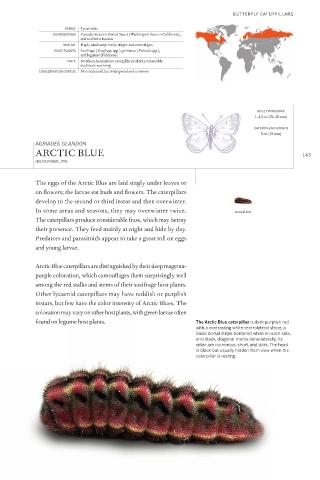
            Arctic Blue caterpillars are distinguished by their deep magenta-

            purple coloration, which camouflages them surprisingly well
            among the red stalks and stems of their saxifrage host plants.
            Other lycaenid caterpillars may have reddish or purplish
            instars, but few have the color intensity of Arctic Blues. The
            coloration may vary on other host plants, with green larvae often
            found on legume host plants.                        The Arctic Blue caterpillar is dark purplish red
                                                                with a contrasting white ventrolateral stripe, a
                                                                black dorsal stripe bordered white on each side,
                                                                and black, diagonal marks dorsolaterally. Its
                                                                setae are numerous, short, and dark. The head
                                                                is black but usually hidden from view when the
                                                                caterpillar is resting.

