


Page 143 - The Book of Caterpillars: A Life-Size Guide to Six Hundred Species From Around the World
P. 143
BUTTERFLY CATERPILLARS
FAMILY Riodinidae
DISTRIBUTION Northern Amazon, from Suriname south to Brazil and west
to northern Peru
HABITAT Humid lowland forest, favoring light gaps and forest edges
HOST PLANTS Inga spp.
NOTE Tiny caterpillar that forms a protective association with ants
CONSERVATION STATUS Not evaluated, but not considered threatened
ADULT WINGSPAN
1⅛–1⁄ in (29–33 mm)
CATERPILLAR LENGTH
¾–⁄ in (20–24 mm)
NYMPHIDIUM CACHRUS
NYMPHIDIUM CACHRUS 141
(FABRICIUS, 1787)
The most reliable way to find Nymphidium cachrus caterpillars
is to look for concentrations of ants on the new growth of the
host plant. Invariably, large numbers of ants signal the presence
of the larvae, to which they are avidly attending. Specialized
balloon-shaped setae behind the head and eversible organs on
the rear of the abdomen help the caterpillars call for and appease
their attending ants, who, in turn, protect the caterpillars from
parasitic wasps and invertebrate predators. Indeed, the ants
themselves would be predators if they were not instead offered
the “nectar” produced by these eversible abdominal glands.
Both the caterpillars and the ants that protect them consume
nectar produced by extrafloral nectaries on the host plant leaves.
These nectaries are designed to attract ants, which, in turn,
protect the young shoots of the plants from herbivores. Thus,
by offering their own bribes to the ants, the caterpillars have,
in fact, infiltrated the plant’s own protective association and
are allowed to stay and feed there. The adult, which ecloses
from a green pupa, is sometimes known as the Firestreak for
the touches of fiery orange on its brown-bordered, white wings.
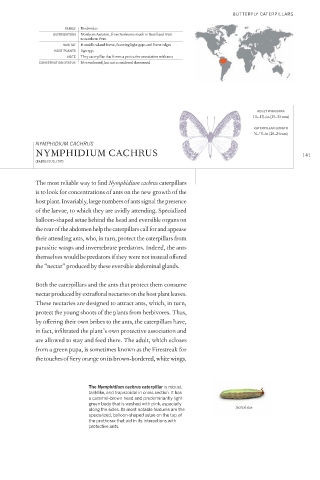
The Nymphidium cachrus caterpillar is robust,
tanklike, and trapezoidal in cross section. It has
a caramel-brown head and predominantly light
green body that is washed with pink, especially
along the sides. Its most notable features are the Actual size
specialized, balloon-shaped setae on the top of
the prothorax that aid in its interactions with
protective ants.

