


Page 147 - The Book of Caterpillars: A Life-Size Guide to Six Hundred Species From Around the World
P. 147
BUTTERFLY CATERPILLARS
FAMILY Lycaenidae
DISTRIBUTION Southern and western United States, Mexico, and south
to Venezuela
HABITAT Desert flats, gullies, roadsides, weedy areas, and salt marshes
HOST PLANTS Chenopodiaceae, including saltbush (Atriplex spp.),
Russian thistle (Salsola spp.), Shoreline Purslane (Sesuvium
portulacastrum), and Black Pigweed (Trianthema portulacastrum)
NOTE One of the smallest butterfly caterpillars in the world
CONSERVATION STATUS Not evaluated, but secure though possibly rare in parts
of its range
ADULT WINGSPAN
¹∕₁₆ in (18 mm)
CATERPILLAR LENGTH
⁷∕₁₆ in (11 mm)
BREPHIDIUM EXILIS
WESTERN PYGMY BLUE 145
(BOISDUVAL, 1852)
The tiny Western Pygmy Blue caterpillar has numerous stubby
setae, giving it a frosted appearance. The eggs hatch in four to
five days, and the emerging caterpillars feed on leaves, flowers,
and seeds, often hiding in bracts. Concealment and camouflage
help protect them, as does attendance by ants, which deter Actual size
predators and parasitoids. The caterpillars develop rapidly, with
pupation occurring after about three weeks; the adults emerge
eight to ten days later. There is no dormancy stage, and breeding
continues year round in the southern United States and Mexico.
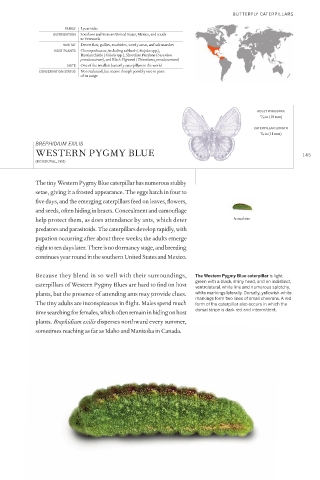
Because they blend in so well with their surroundings, The Western Pygmy Blue caterpillar is light
caterpillars of Western Pygmy Blues are hard to find on host green with a black, shiny head, and an indistinct,
ventrolateral, white line and numerous splotchy,
plants, but the presence of attending ants may provide clues. white markings laterally. Dorsally, yellowish-white
The tiny adults are inconspicuous in flight. Males spend much markings form two lines of small chevrons. A red
form of the caterpillar also occurs in which the
time searching for females, which often remain in hiding on host dorsal stripe is dark red and intermittent.
plants. Brephidium exilis disperses northward every summer,
sometimes reaching as far as Idaho and Manitoba in Canada.

