


Page 20 - The Book of Caterpillars: A Life-Size Guide to Six Hundred Species From Around the World
P. 20
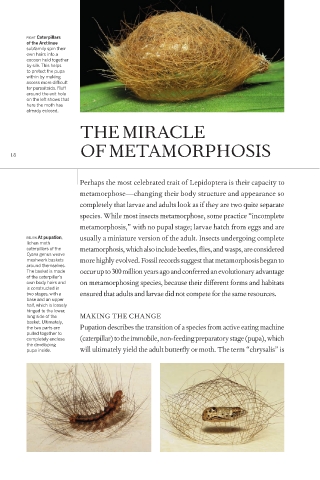
RIGHT Caterpillars
          of the Arctiinae
          subfamily spin their
          own hairs into a
          cocoon held together
          by silk. This helps
          to protect the pupa
          within by making
          access more difficult
          for parasitoids. Fluff
          around the exit hole
          on the left shows that
          here the moth has
          already eclosed.
                           THE MIRACLE


                           OF METAMORPHOSIS

    18
    18


                           Perhaps the most celebrated trait of Lepidoptera is their capacity to

                           metamorphose—changing their body structure and appearance so
                           completely that larvae and adults look as if they are two quite separate
                           species. While most insects metamorphose, some practice “incomplete
                           metamorphosis,” with no pupal stage; larvae hatch from eggs and are

          BELOW At pupation,   usually a miniature version of the adult. Insects undergoing complete
          lichen moth
          caterpillars of the   metamorphosis, which also include beetles, flies, and wasps, are considered
          Cyana genus weave
          meshwork baskets   more highly evolved. Fossil records suggest that metamorphosis began to
          around themselves.
          The basket is made   occur up to 300 million years ago and conferred an evolutionary advantage
          of the caterpillar’s
          own body hairs and   on metamorphosing species, because their different forms and habitats
          is constructed in
          two stages, with a   ensured that adults and larvae did not compete for the same resources.
          base and an upper
          half, which is loosely
          hinged to the lower,
          long side of the   MAKING THE CHANGE
          basket. Ultimately,
          the two parts are   Pupation describes the transition of a species from active eating machine
          pulled together to
          completely enclose   (caterpillar) to the immobile, non-feeding preparatory stage (pupa), which
          the developing
          pupa inside.     will ultimately yield the adult butterfly or moth. The term “chrysalis” is

