


Page 162 - The Book of Caterpillars: A Life-Size Guide to Six Hundred Species From Around the World
P. 162
BUTTERFLY CATERPILLARS
FAMILY Lycaenidae
DISTRIBUTION Across Europe and Africa, central and South Asia, southern parts
of China, Southeast Asia, Australia, New Zealand, and Hawaii
HABITAT Grasslands, downlands, waste grounds, and gardens
HOST PLANTS Cytisus spp., Lathyrus spp., Medicago spp., and other members
of family Fabaceae
NOTE Sluglike caterpillar that kills fellow larvae
CONSERVATION STATUS Not evaluated, but widespread and common in much of its range
ADULT WINGSPAN
⁄–1⁄ in (24–34 mm)
CATERPILLAR LENGTH
⅜–½ in (10–12 mm)
LAMPIDES BOETICUS
LONG-TAILED BLUE
160
(LINNAEUS, 1767)
Long-tailed Blue caterpillars hatch from eggs laid singly by
the female butterfly on the flowers and flower buds of the host
plants. The larvae feed on flowers first and then move to the
pods, where they burrow inside to eat the seeds. The caterpillars
pupate within the withered pods and leaves, which fall to the
Actual size
ground. Unusually, the caterpillars are cannibalistic, attacking
one another until only one caterpillar survives on each plant.
In some areas, the caterpillars are tended by ants that milk them
for a sugary secretion and probably provide some protection
against parasitoid wasps and flies.
The adults are on the wing in summer, and in many areas
there are several overlapping generations. The species is most
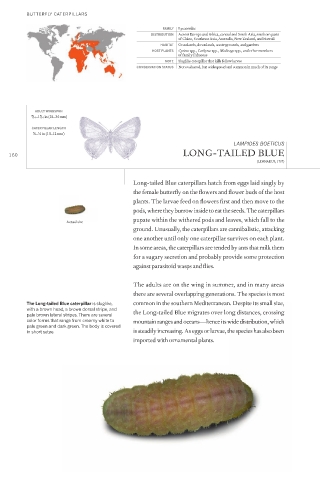
The Long-tailed Blue caterpillar is sluglike, common in the southern Mediterranean. Despite its small size,
with a brown head, a brown dorsal stripe, and the Long-tailed Blue migrates over long distances, crossing
pale brown lateral stripes. There are several
color forms that range from creamy white to mountain ranges and oceans—hence its wide distribution, which
pale green and dark green. The body is covered
in short setae. is steadily increasing. As eggs or larvae, the species has also been
imported with ornamental plants.

