


Page 163 - The Book of Caterpillars: A Life-Size Guide to Six Hundred Species From Around the World
P. 163
BUTTERFLY CATERPILLARS

                      FAMILY  Lycaenidae
                  DISTRIBUTION  Africa, across southern and eastern Europe, and Asia Minor
                           as far as the Himalayas
                     HABITAT  Grasslands, wastelands, parks, and gardens
                  HOST PLANTS  Wide range, including hawthorn (Crataegus spp.), Melilotus spp.,
                           and Plumbago spp.

                      NOTE  Plump caterpillar that feeds on flowers and seeds
             CONSERVATION STATUS  Not evaluated


                                                                                   ADULT WINGSPAN
                                                                                  ¾–1⅛ in (20–29 mm)
                                                                                  CATERPILLAR LENGTH
                                                                                    ⅜ in (10 mm)
            LEPTOTES PIRITHOUS
            COMMON ZEBRA BLUE                                                                    161

            (LINNAEUS, 1767)


            Common Zebra Blue caterpillars hatch from eggs laid by
            the female butterfly close to flower buds and flowers. They
            feed on the flowers and later the seeds, and their complete
            life cycle through pupation to adult eclosion and fl ight takes
            between four and eight weeks, depending on the climate. The     Actual size
            fast-flying species is on the wing from February to October,


            and there are several generations a year. The pupae of the final
            generation overwinter.

            Common Zebra Blues tend to occur singly and in small groups,
            but large congregations have been recorded around nectar plants
            such as lucerne crops. Despite its small size, the butterfly is a

            strong flier and migrates over long distances, including oceans.

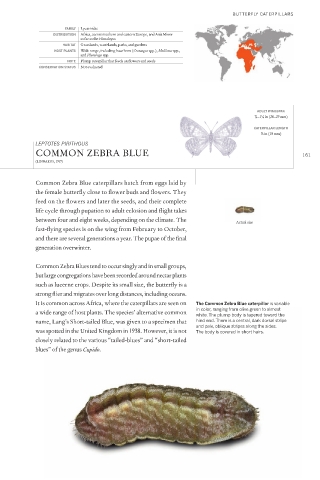
            It is common across Africa, where the caterpillars are seen on   The Common Zebra Blue caterpillar is variable
            a wide range of host plants. The species’ alternative common   in color, ranging from olive green to almost
                                                                white. The plump body is tapered toward the
            name, Lang’s Short-tailed Blue, was given to a specimen that   hind end. There is a central, dark dorsal stripe
            was spotted in the United Kingdom in 1938. However, it is not   and pale, oblique stripes along the sides.
                                                                The body is covered in short hairs.
            closely related to the various “tailed-blues” and “short-tailed
            blues” of the genus Cupido.

