


Page 164 - The Book of Caterpillars: A Life-Size Guide to Six Hundred Species From Around the World
P. 164
BUTTERFLY CATERPILLARS
FAMILY Lycaenidae
DISTRIBUTION From northeastern India through areas of Southeast Asia to
New Guinea and northern Australia
HABITAT Range of tropical lowland environments, including mangroves,
riparian rain forests, open forests, and urban areas
HOST PLANTS Feeds on the larvae of Green Tree Ants (Oecophylla smaragdina)
NOTE Predatory caterpillar that lives within arboreal Green Tree
Ant nests
CONSERVATION STATUS Not evaluated, although uncommon and rarely seen
ADULT WINGSPAN
2⁄–3 in (71–76 mm)
CATERPILLAR LENGTH
1⅓– 1⁄ in (26–30 mm)
LIPHYRA BRASSOLIS
MOTH BUTTERFLY
162
WESTWOOD, [1864]
The Moth Butterfly caterpillar hatches on or near the arboreal
nest of the Green Tree Ant. It enters the nest to consume ant
larvae; usually no more than one or two caterpillars feed in one
nest. The caterpillar’s head senses ant brood, and the antennae
are used to pull ant larvae to the mouthparts so they can be
consumed without attack from adult ants. Young caterpillars
probably produce chemicals that allay ant aggression as small
caterpillars would be easy prey for the ants. Larger caterpillars
have a cuticle comprising overlapping, scale-like, setal sockets
that provides a strong, flexible mechanical barrier. A caterpillar
can devour all green ant larvae in one nest.
Pupation occurs within the ant nest in the caterpillar’s final instar
skin. Upon emerging, the butterfly is protected by white scales
on its new wings that clog the mandibles of the attacking ants.
In some regions of Southeast Asia, ant larvae and pupae from
these easily accessible nests are harvested for human food, and
the Moth Butterfly caterpillars are typically consumed as well.
Actual size
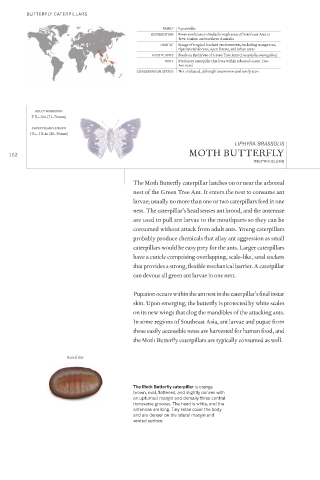
The Moth Butter y caterpillar is orange
brown, oval, attened, and slightly convex with
an upturned margin and dorsally three central
transverse grooves. The head is white, and the
antennae are long. Tiny setae cover the body
and are denser on the lateral margin and
ventral surface.

