


Page 165 - The Book of Caterpillars: A Life-Size Guide to Six Hundred Species From Around the World
P. 165
BUTTERFLY CATERPILLARS

                      FAMILY  Lycaenidae
                  DISTRIBUTION  France, the Netherlands, and eastern Europe into
                           Russia and Kazakhstan
                     HABITAT  Damp grasslands and meadows, and marshes
                  HOST PLANTS  Various docks and sorrels (Rumex spp.)

                      NOTE  Well-camouflaged green caterpillar that is found
                           in wetland habitats
             CONSERVATION STATUS  Near threatened


                                                                                   ADULT WINGSPAN
                                                                                  1⅛–1¼ in (28–32 mm)
                                                                                  CATERPILLAR LENGTH
                                                                                    ¾ in (20 mm)
            LYCAENA DISPAR
            LARGE COPPER                                                                         163

            (HAWORTH, 1803)


            The female Large Copper lays eggs, either singly or in small
            groups, on the leaves of host plants found near water. Two weeks
            later the eggs hatch, and the caterpillars feed on the underside of
            leaves, leaving the upper surface intact. Their nibbling creates a
            small groove in which the young larvae rest. As they get older,
            they feed on the whole leaf. The young caterpillar overwinters
            at the base of the host plant and is able to survive for as long as
            two months underwater if its habitat floods in winter. It resumes

            feeding and pupates the following spring as a yellow-brown
            chrysalis attached by silk to the host plant stem.


            The adults, which have beautiful, iridescent copper wings, eclose

            and fly from June to July. The species has experienced a severe
            decline in much of its range due to the loss of its wetland habitats.
            In some regions, notably the United Kingdom, the species
            became extinct, and there have been several failed attempts
            to reintroduce it.


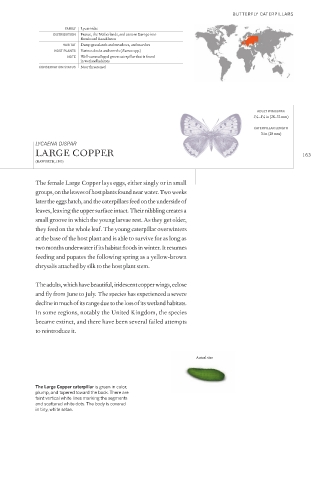
                                                                Actual size


            The Large Copper caterpillar is green in color,
            plump, and tapered toward the back. There are
            faint vertical white lines marking the segments
            and scattered white dots. The body is covered
            in tiny, white setae.

