


Page 166 - The Book of Caterpillars: A Life-Size Guide to Six Hundred Species From Around the World
P. 166
BUTTERFLY CATERPILLARS

                                                     FAMILY  Lycaenidae
                                                 DISTRIBUTION  Northwestern United States, from Washington State to California
                                                          and east to Colorado and Montana
                                                    HABITAT  Montane meadows and roadsides
                                                  HOST PLANTS  Knotweed and smartweed (Polygonum spp.), and docks and sorrels
                                                          (Rumex spp.)
                                                      NOTE  Slow-moving, cryptic caterpillar that produces fast-moving,

                                                          dazzling butterfly
                                             CONSERVATION STATUS  Not evaluated, but common


            ADULT WINGSPAN
           1–1³∕₁₆ in (25–30 mm)
           CATERPILLAR LENGTH
             ¾ in (20 mm)
                                                                               LYCAENA EDITHA
                                                                EDITH’S COPPER
    164
                                                                                     (MEAD, 1878)


                                            Edith’s Copper caterpillars hatch in late spring from
                                            overwintering eggs and feed voraciously, completing their
                                            development through four instars within three weeks. The
                                            larvae feed only on leaves, grazing mostly on the lower surfaces,
                                            eventually eating holes through them and later feeding on leaf
                                            edges. No nests are built. The green caterpillars depend on
                                            camouflage for protection, and attendance by ants is common,

                                            aiding defense from predators and parasitoids. The pupae hatch
                      Actual size
                                            in early summer, and there is a single generation annually.


                                            The range of hosts used by Edith’s Copper is uncertain, and it
                                            is possible that many other species in the Polygonaceae family

                                            are utilized. The adults are strongly attracted to flowers such as
                                            Yarrow (Achillea millefolium) and aster (Asteraceae), and males
                                            aggressively guard low perches. Lycaena editha can be abundant

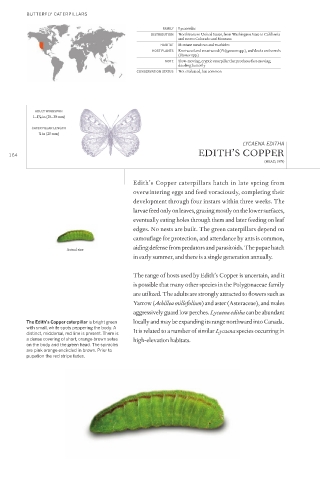
         The Edith’s Copper caterpillar is bright green   locally and may be expanding its range northward into Canada.
         with small, white spots peppering the body. A   It is related to a number of similar Lycaena species occurring in
         distinct, middorsal, red line is present. There is
         a dense covering of short, orange-brown setae   high-elevation habitats.
         on the body and the green head. The spiracles
         are pink orange encircled in brown. Prior to
         pupation the red stripe fades.

