


Page 167 - The Book of Caterpillars: A Life-Size Guide to Six Hundred Species From Around the World
P. 167
BUTTERFLY CATERPILLARS

                      FAMILY  Lycaenidae
                  DISTRIBUTION  Southern mainland Australia, Tasmania
                     HABITAT  Heathland, ranging from alpine to semi-arid inland areas
                  HOST PLANTS  Native peas of the Fabaceae family, including Gorse Bitter-pea
                           (Daviesia ulicifolia), other Daviesia spp., Aotus spp., and
                           Bossiaea spp.


                      NOTE  Caterpillar camouflaged to match the color of flowers it feeds on
             CONSERVATION STATUS  Not evaluated, but locally common


                                                                                   ADULT WINGSPAN
                                                                                    ¾ in (20 mm)
                                                                                  CATERPILLAR LENGTH
                                                                                    ½ in (12 mm)
            NEOLUCIA AGRICOLA
            FRINGED HEATH-BLUE                                                                   165

            (WESTWOOD, [1851])


            Fringed Heath-blue caterpillars hatch in the early spring from
            eggs laid during the previous spring or early summer. Hatching
            coincides with the flowering of the food plants. The early instars


            burrow into the calyx, feeding within the flower, while the larger

            caterpillars consume entire flowers. The mature caterpillars are


            difficult to find as they blend in with the red and yellow flowers


            on which they are feeding. The caterpillars develop rapidly,
            and adults are flying by the end of spring. There is only one    Actual size

            generation a year.
            The caterpillars pupate on the stems of the food plant. The adults
            fly close to the ground, and males are known to fly on hilltops.


            The genus contains only three species, every one confined to

            Australia. The caterpillars of all species are usually not attended
            by ants, but occasionally, in Western Australia, ants have been
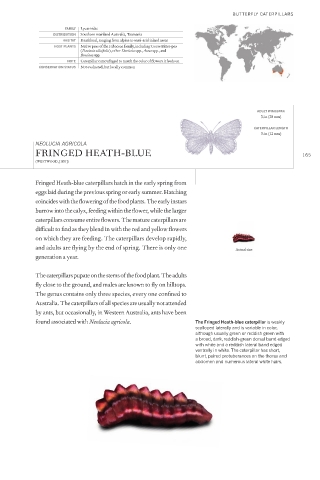
            found associated with Neolucia agricola.           The Fringed Heath-blue caterpillar is weakly
                                                               scalloped laterally and is variable in color,
                                                               although usually green or reddish green with
                                                               a broad, dark, reddish-green dorsal band edged
                                                               with white and a reddish lateral band edged
                                                               ventrally in white. The caterpillar has short,
                                                               blunt, paired protuberances on the thorax and
                                                               abdomen and numerous lateral white hairs.

