Page 168 - The Book of Caterpillars: A Life-Size Guide to Six Hundred Species From Around the World
P. 168
BUTTERFLY CATERPILLARS

                                                     FAMILY  Lycaenidae
                                                   TRIBUTION
                                                 DISTRIBUTION
                                                 DISTRIBUTION  Inland eastern Australia
                                                 DIS
                                                    HABIT
                                                    HABITAT T  Arid to semi-arid acacia woodlands
                                                    HABITAT
                                                       A
                                                  HOST PLANTS
                                                  HOST PLANTS
                                                  HOS T PLANT S  Grey Mistletoe (Amyema quandang)
                                                      NOTE
                                                      NO TE  Nocturnal-feeding caterpillar that is often attended by small ants
                                                      NOTE
                                             CONSERV
                                                     T
                                             CONSERVATION STATUS  Not evaluated, but large areas of known habitat have been
                                             CONSERVATION STATUS
                                                 A
                                                  TION S
                                                      TUS
                                                      A
                                                          cleared for agriculture
            ADULT WINGSPAN
             1⁄ in (34 mm)
           CATERPILLAR LENGTH
             ⅞ in (22 mm)
                                                                             OGYRIS BARNARDI
                                                     BRIGHT PURPLE AZURE
    166
                                                                                     (MISKIN, 1890)
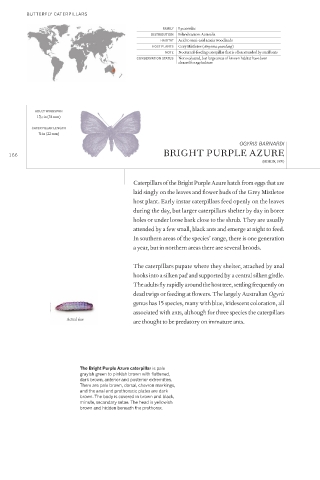
                                            Caterpillars of the Bright Purple Azure hatch from eggs that are
                                            laid singly on the leaves and flower buds of the Grey Mistletoe

                                            host plant. Early instar caterpillars feed openly on the leaves
                                            during the day, but larger caterpillars shelter by day in borer
                                            holes or under loose bark close to the shrub. They are usually
                                            attended by a few small, black ants and emerge at night to feed.
                                            In southern areas of the species’ range, there is one generation
                                            a year, but in northern areas there are several broods.


                                            The caterpillars pupate where they shelter, attached by anal
                                            hooks into a silken pad and supported by a central silken girdle.

                                            The adults fly rapidly around the host tree, settling frequently on
                                            dead twigs or feeding at flowers. The largely Australian Ogyris

                                            genus has 15 species, many with blue, iridescent coloration, all
                                            associated with ants, although for three species the caterpillars
                      Actual size           are thought to be predatory on immature ants.


                           The Bright Purple Azure caterpillar is pale
                           grayish green to pinkish brown with   attened,
                           dark brown, anterior and posterior extremities.
                           There are pale brown, dorsal, chevron markings,
                           and the anal and prothoracic plates are dark
                           brown. The body is covered in brown and black,
                           minute, secondary setae. The head is yellowish
                           brown and hidden beneath the prothorax.
   163   164   165   166   167   168   169   170   171   172   173