


Page 21 - The Book of Caterpillars: A Life-Size Guide to Six Hundred Species From Around the World
P. 21
THE MIRACLE OF METAMORPHOSIS


                                                                                                  19


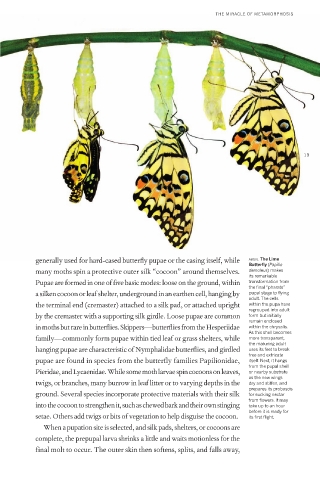
            generally used for hard-cased butterfly pupae or the casing itself, while   ABOVE  The Lime
                                                                                Butterfly (Papilio
            many moths spin a protective outer silk “cocoon” around themselves.  demoleus) makes
                                                                                its remarkable
            Pupae are formed in one of five basic modes: loose on the ground, within   transformation from
                                                                                the final “pharate”
            a silken cocoon or leaf shelter, underground in an earthen cell, hanging by   pupal stage to flying
                                                                                adult. The cells
            the terminal end (cremaster) attached to a silk pad, or attached upright     within the pupa have
                                                                                regrouped into adult
            by the cremaster with a supporting silk girdle. Loose pupae are common   form but initially
                                                                                remain enclosed
            in moths but rare in butterflies. Skippers—butterflies from the Hesperiidae   within the chrysalis.
                                                                                As this shell becomes
            family—commonly form pupae within tied leaf or grass shelters, while   more transparent,
                                                                                the maturing adult
            hanging pupae are characteristic of Nymphalidae butterflies, and girdled   uses its feet to break
                                                                                free and extricate
            pupae are found in species from the butterfly families Papilionidae,   itself. Next, it hangs
                                                                                from the pupal shell
            Pieridae, and Lycaenidae. While some moth larvae spin cocoons on leaves,   or nearby substrate
                                                                                as the new wings
            twigs, or branches, many burrow in leaf litter or to varying depths in the   dry and stiffen, and
                                                                                prepares its proboscis
            ground. Several species incorporate protective materials with their silk   for sucking nectar
                                                                                from flowers. It may
            into the cocoon to strengthen it, such as chewed bark and their own stinging   take up to an hour
                                                                                before it is ready for
            setae. Others add twigs or bits of vegetation to help disguise the cocoon.   its first flight.
               When a pupation site is selected, and silk pads, shelters, or cocoons are
            complete, the prepupal larva shrinks a little and waits motionless for the
            final molt to occur. The outer skin then softens, splits, and falls away,

