


Page 23 - The Book of Caterpillars: A Life-Size Guide to Six Hundred Species From Around the World
P. 23
THE MIRACLE OF METAMORPHOSIS


            at the larval stage, which will now develop into adult body parts. In some

            species, this metamorphosis is rapid, taking as little as five to seven days.
            In others, pupae oversummer and overwinter in a dormant state, or
            diapause, sometimes for two or three years. A few days before a butterfly
            or moth emerges, or ecloses, the pupa darkens, indicating the advanced

            stage of development. On the final day, as the shell becomes increasingly
            transparent, first the patterns and color of the wings, then the rest of the
            body, can be seen. At this “pharate” pupa stage, eclosion is just hours away,
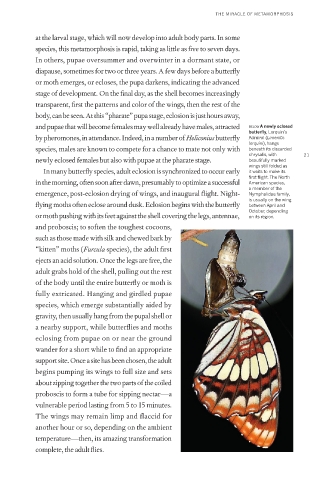
            and pupae that will become females may well already have males, attracted   BELOW A newly eclosed
                                                                                butterfly, Lorquin’s
            by pheromones, in attendance. Indeed, in a number of Heliconius butterfly   Admiral (Limenitis
                                                                                lorquini), hangs
            species, males are known to compete for a chance to mate not only with   beneath its discarded
                                                                                chrysalis, with   21
                                                                                                  21
            newly eclosed females but also with pupae at the pharate stage.     beautifully marked
                                                                                wings still folded as
               In many butterfly species, adult eclosion is synchronized to occur early   it waits to make its
                                                                                first flight. The North
            in the morning, often soon after dawn, presumably to optimize a successful   American species,
                                                                                a member of the
            emergence, post-eclosion drying of wings, and inaugural flight. Night-  Nymphalidae family,
            flying moths often eclose around dusk. Eclosion begins with the butterfly   is usually on the wing
                                                                                between April and
            or moth pushing with its feet against the shell covering the legs, antennae,   October, depending
                                                                                on its region.
            and proboscis; to soften the toughest cocoons,
            such as those made with silk and chewed bark by
            “kitten” moths (Furcula species), the adult first

            ejects an acid solution. Once the legs are free, the
            adult grabs hold of the shell, pulling out the rest
            of the body until the entire butterfly or moth is
            fully extricated. Hanging and girdled pupae

            species, which emerge substantially aided by
            gravity, then usually hang from the pupal shell or
            a nearby support, while butterflies and moths
            eclosing from pupae on or near the ground
            wander for a short while to find an appropriate

            support site. Once a site has been chosen, the adult
            begins pumping its wings to full size and sets
            about zipping together the two parts of the coiled
            proboscis to form a tube for sipping nectar—a

            vulnerable period lasting from 5 to 15 minutes.
            The wings may remain limp and flaccid for
            another hour or so, depending on the ambient
            temperature—then, its amazing transformation
            complete, the adult flies.

