


Page 193 - The Book of Caterpillars: A Life-Size Guide to Six Hundred Species From Around the World
P. 193
BUTTERFLY CATERPILLARS

                      FAMILY  Nymphalidae
                  DISTRIBUTION
                  DISTRIBUTION  North America, from southern Canada to central United States
                    TRIBUTION
                  DIS
                     HABIT
                     HABITAT T  Mid–high elevation, lightly forested, hilly, and mountainous areas
                        A
                     HABITAT
                  HOS T PLANT S  Violet (Viola spp.)
                  HOST PLANTS
                  HOST PLANTS

                        TE
                      NOTE
                      NOTE  Spiny caterpillar that lives on the forest  oor
                      NO
             CONSERV A TION S T A TUS  Not evaluated, but common
             CONSERVATION STATUS
             CONSERVATION STATUS
                                                                                   ADULT WINGSPAN
                                                                                  2¾–3 in (70–75 mm)
                                                                                  CATERPILLAR LENGTH
            ARGYNNIS CYBELE                                                       1¾–2 in (45–50 mm)
            GREAT SPANGLED
            FRITILLARY                                                                           191
            (FABRICIUS, 1775)


            Great Spangled Fritillary females lay their eggs singly in
            late summer and early fall on the forest floor where violets
            are present. The newly hatched caterpillars do not feed but
            overwinter in dormancy under plant debris, fallen branches,
            stones, and rocks. Feeding commences when violets begin to
            grow in spring. The larvae are mostly nocturnal, rarely seen,

            and feed chie y at night. Second and later instar caterpillars have
            an eversible ventral “neck” gland that produces a musky odor
            when disturbed. This likely provides protection from ground-
            crawling natural enemies, such as ants and ground beetles.


            Like other fritillaries, the caterpillars develop through six instars   Actual size
            over a period of about two months. Their pupae are more
            wriggly than other fritillary species and are formed close to the
            ground under a protective tent made of silked-together leaves.
            Adults emerge in June, and the females are relatively inactive
            for a month or so, preferring to shelter in cool areas before they
            start to lay eggs.


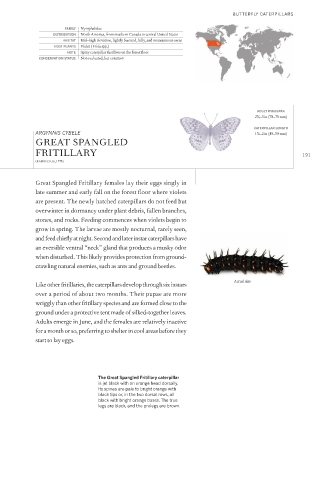
                                The Great Spangled Fritillary caterpillar
                                is jet black with an orange head dorsally.
                                Its spines are pale to bright orange with
                                black tips or, in the two dorsal rows, all
                                black with bright orange bases. The true
                                legs are black, and the prolegs are brown.

