


Page 189 - The Book of Caterpillars: A Life-Size Guide to Six Hundred Species From Around the World
P. 189
BUTTERFLY CATERPILLARS
FAMILY Nymphalidae
DISTRIBUTION Most of Europe and the Middle East, across central Asia to
China and Japan
HABITAT Sheltered places in damp woodlands, woodland margins and
glades, and hedgerows
HOST PLANTS Grasses, including Cock’s-foot (Dactylis glomerata),
meadow grass (Poa spp.), and Couch Grass (Elytrigia repens)
NOTE Solitary caterpillar that emerges at night to feed
CONSERVATION STATUS Not evaluated, but common in most parts of its range
ADULT WINGSPAN
1⅝–2⁄ in (42–52 mm)
CATERPILLAR LENGTH
1 in (25 mm)
APHANTOPUS HYPERANTUS
RINGLET 187
(LINNAEUS, 1758)
Ringlet caterpillars hatch from eggs scattered by the female
while flying over grass. These solitary caterpillars are nocturnal,
hiding during the day near the base of grass tussocks and
emerging at night to feed on young leaves. If disturbed, they
drop to the ground and remain still to avoid predation. The
larvae hibernate, although they will feed during mild weather,
becoming fully active again in spring. Pupation takes place in
early summer when the mature caterpillars move to the base
of the grass plant.
There is a single generation a year. The adults, which live for
about two weeks, are on the wing during summer months,
spending time resting on blades of grass and, unusually, flying
on overcast days and even in the rain. Aphantopus hyperantus is
not threatened—in fact, studies have shown it to be increasing
in parts of its range, including the United Kingdom.
Actual size
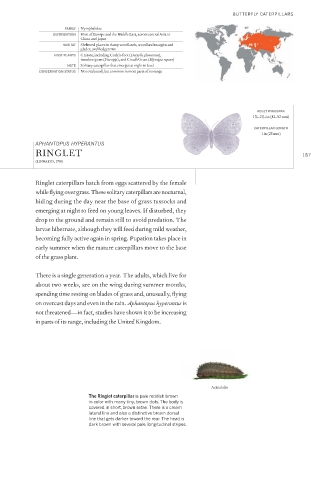
The Ringlet caterpillar is pale reddish brown
in color with many tiny, brown dots. The body is
covered in short, brown setae. There is a cream
lateral line and also a distinctive brown dorsal
line that gets darker toward the rear. The head is
dark brown with several pale, longitudinal stripes.

