


Page 196 - The Book of Caterpillars: A Life-Size Guide to Six Hundred Species From Around the World
P. 196
BUTTERFLY CATERPILLARS

                                                     FAMILY  Nymphalidae
                                                   TRIBUTION
                                                 DISTRIBUTION  Eastern North America into Mexico
                                                 DIS
                                                 DISTRIBUTION
                                                    HABITAT
                                                    HABITAT T  Forest woodlands
                                                    HABIT
                                                       A
                                                  HOST PLANTS
                                                  HOS
                                                  HOST PLANTS S  Hackberry (Celtis spp.)
                                                    T PLANT
                                                      NOTE
                                                      NOTE  Gregarious caterpillar that becomes solitary as it matures
                                                       TE
                                                      NO
                                                     T
                                             CONSERVATION STATUS
                                             CONSERV
                                                  TION S
                                                      A
                                                      TUS
                                                 A
                                             CONSERVATION STATUS  Not evaluated, but secure throughout most of its range
            ADULT WINGSPAN
           1⅝–2¾ in (42–70 mm)
           CATERPILLAR LENGTH
             1     in (40 mm)
                                                                          ASTEROCAMPA CLYTON
                                                               TAWNY EMPEROR
    194
                                                                            BOISDUVAL & LECONTE, 1835
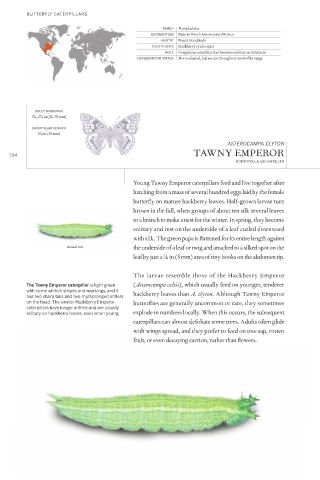
                                            Young Tawny Emperor caterpillars feed and live together after
                                            hatching from a mass of several hundred eggs laid by the female

                                            butter y on mature hackberry leaves. Half-grown larvae turn
                                            brown in the fall, when groups of about ten silk several leaves
                                            to a branch to make a nest for the winter. In spring, they become
                                            solitary and rest on the underside of a leaf curled downward
                                            with silk. The green pupa is  attened for its entire length against

                      Actual size           the underside of a leaf or twig and attached to a silked spot on the
                                            leaf by just a ⅛ in (3 mm) area of tiny hooks on the abdomen tip.


                                            The larvae resemble those of the Hackberry Emperor
         The Tawny Emperor caterpillar is light green   (Asterocampa celtis), which usually feed on younger, tenderer
         with some whitish stripes and markings, and it   hackberry leaves than A. clyton. Although Tawny Emperor
         has two sharp tails and two multipronged antlers
         on the head. The similar Hackberry Emperor   butter  ies are generally uncommon or rare, they sometimes
         caterpillars have longer antlers and are usually
         solitary on hackberry leaves, even when young.  explode in numbers locally. When this occurs, the subsequent
                                            caterpillars can almost defoliate some trees. Adults often glide
                                            with wings spread, and they prefer to feed on tree sap, rotten

                                            fruit, or even decaying carrion, rather than  owers.

