


Page 195 - The Book of Caterpillars: A Life-Size Guide to Six Hundred Species From Around the World
P. 195
BUTTERFLY CATERPILLARS

                      FAMILY  Nymphalidae
                  DISTRIBUTION
                  DISTRIBUTION
                  DIS TRIBUTION  Southern and eastern United States, extending into Mexico

                     HABIT A T  Woodland edges, riparian areas, and  elds
                     HABITAT
                     HABITAT
                  HOST PLANTS
                  HOST PLANTS
                  HOS T PLANT S  Hackberry (Celtis spp.)

                      NOTE
                      NO TE  Thorny-headed, long-tailed, camou aged caterpillar
                      NOTE
                   TION S
                  A
                      T
                       A
                       TUS
             CONSERVATION STATUS
             CONSERV
             CONSERVATION STATUS  Not evaluated, but common
                                                                                   ADULT WINGSPAN
                                                                                  1 ⁄  –1⅞ in (40–47 mm)
                                                                                  CATERPILLAR LENGTH


                                                                                  1 ⁄  –1⅜ in (30–35 mm)
            ASTEROCAMPA CELTIS
            HACKBERRY EMPEROR                                                                    193
            (BOISDUVAL & LECONTE, 1835)

            Female Hackberry Emperor butter ies lay their white or pale
            yellow eggs singly or in small groups on the underside of
            Hackberry leaves, choosing trees with new growth. Young
            caterpillars rest there and are particularly easy to see at night

            if you shine a  ashlight upward. Third instars turn brown and
            overwinter in rolled leaves, sometimes falling to the ground
            in the fall. In spring, the larvae climb back up the tree and

            resume feeding. Many di erent kinds of insect predators feed
            on Hackberry Emperor caterpillars, and some fly and wasp
            parasitoids destroy both caterpillars and pupae.


            In northerly parts of the range, only one generation is produced
            annually, but two or three generations appear elsewhere. The
            adults have a very rapid   ight, and males perch on foliage to
            await females or aggressively patrol territories. The females
            are less active than the males, but both sexes can be attracted to
            rotting fruit baits.


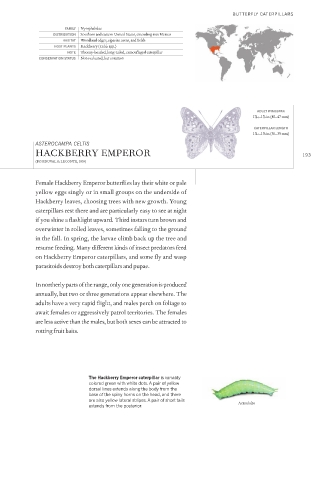
                             The Hackberry Emperor caterpillar is variably
                             colored green with white dots. A pair of yellow
                             dorsal lines extends along the body from the
                             base of the spiny horns on the head, and there
                             are also yellow lateral stripes. A pair of short tails   Actual size
                             extends from the posterior.

